
The wording itself, not a paraphrase
Three provisions decide who answers for what
The whole question is settled by 3 places in the Act: article 49, paragraph 3, the chapter on offences, and article 73. They are copied here as they stand, including the one that texts claiming the opposite rely on.
| Casino | Licence | Company | Threshold for checks | Open |
|---|---|---|---|---|
| Vave | Curaçao Gaming Authority | Latcas B.V. | at discretion | Go to the casino siteRead |
| Vave pays for the single link that leaves this site, and that is the whole of our commercial relationship with it. Its sportsbook and its casino sit on one account, so the same money covers both without a second stake — uncommon among operators that advertise themselves as crypto casinos. We read the licence number ourselves on 2 September 2026 in the Curaçao Gaming Authority register: OGL/2024/1676/0905, held by Latcas B.V., issued 19 May 2025, status active. | ||||
| Rocketpot | Curacao | Danneskjold Ventures B.V. | US$2,500 | Go to the casino siteRead |
| Bitcasino.io | Curaçao Gaming Authority | Moon Technologies B.V. | 2,500 EUR | Go to the casino siteRead |
| Wild Fortune | Anjouan Gaming Board | Metlait SRL | at discretion | Go to the casino siteRead |
| DuckDice | Anjouan Gaming Board | Zentari Limitada | at discretion | Go to the casino siteRead |
| Empire.io | Anjouan Gaming Board | Pixel Entertainment Limited | 2,000 USDT | Go to the casino siteRead |
| Metaspins | Curaçao Gaming Authority | Metaspins N.V. | at discretion | Go to the casino siteRead |
| Rainbet | Anjouan Gaming Board | RBGAMING N.V. | at discretion | Go to the casino siteRead |
| Shuffle | Curaçao Gaming Authority | Natural Nine B.V. | at discretion | Go to the casino siteRead |
| Wild.io | Curaçao Gaming Authority | Nonce Gaming B.V. | at discretion | Go to the casino siteRead |


The provision that settles the question in one sentence
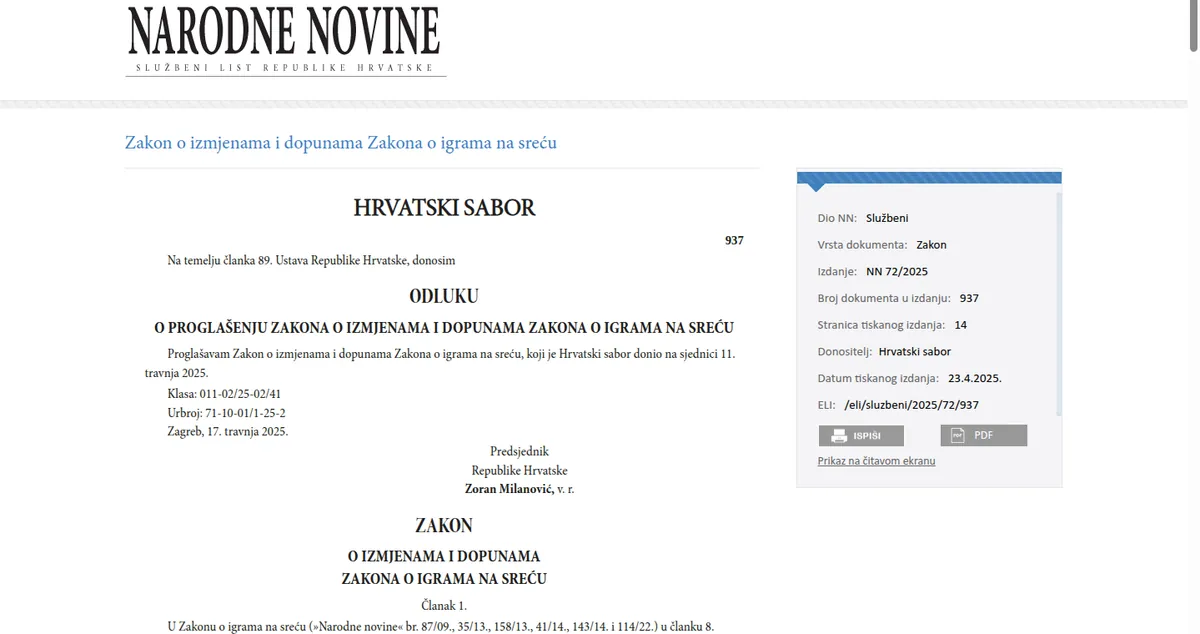
Zakon o igrama na sreću, the Croatian Gaming Act, was published in issues of Narodne novine numbered 87/09, 35/13, 158/13, 41/14, 143/14, 114/22 and 72/25, and the consolidated text carries the marking “na snazi od 01.05.2025.” — in force from 1 May 2025.
Article 49 is headed “Identifikacija igrača i zabrana sudjelovanja maloljetnika…”, the identification of players and the prohibition on minors taking part. Its first two paragraphs set the prohibitions:
(1) “Sudjelovanje u igrama klađenja i igrama na automatima koje se priređuju na uplatnim mjestima kladionica dopušteno je samo osobama koje su se identificirale.” (2) “Zabranjuje se posjet uplatnim mjestima kladionica i sudjelovanje u igrama na sreću osobama mlađim od 18 godina.”
In English: participation in betting games and slot games offered at betting shop counters is permitted only to persons who have identified themselves; and visits to betting shop counters and participation in games of chance are prohibited to persons under 18.
The third paragraph says who answers for them:
(3) “Odgovornost za provođenje zabrana iz stavaka 1. i 2. ovoga članka snosi priređivač.”
Responsibility for enforcing the prohibitions in paragraphs 1 and 2 of this article rests with the operator. The sentence is short and it is not ambiguous. The Act placed the burden of enforcement on whoever runs the game.
Who may organise at all, under article 3
Before any penalty, the Act settles the question of entitlement, and it does so in four paragraphs of a single article.
(1) “Priređivanje igara na sreću na području Republike Hrvatske pravo je Republike Hrvatske, ako ovim Zakonom nije drukčije određeno.” (2) “Igre na sreću mogu se priređivati na temelju ovoga Zakona, odluke Vlade Republike Hrvatske i odobrenja Ministarstva financija.”
That is: organising games of chance on the territory of the Republic of Croatia is a right of the Republic of Croatia unless this Act provides otherwise; and games of chance may be organised on the basis of this Act, a decision of the Government and an approval of the Ministry of Finance.
There are three instruments, then, and not one of them is an application to an open tender. Paragraph 3 transfers that right to Hrvatska Lutrija d.o.o., a company founded by the state itself, and paragraph 4 opens a door for others:
“Pravo priređivanja igara na sreću iz članka 5. stavka 1. točke 2., 3. i 4. ovoga Zakona mogu na temelju odluke i odobrenja steći i druga trgovačka društva sa sjedištem u Republici Hrvatskoj.”
The right to organise the games under article 5, paragraph 1, points 2, 3 and 4 may also be acquired, on the basis of a decision and an approval, by other commercial companies with their seat in the Republic of Croatia.
Points 2, 3 and 4 of article 5 are casino games, betting games and slot games. The first point, lottery games, does not appear in that sentence, because the exclusive right to it is reserved for one company by article 9, paragraph 2; the two are separated on the page about Hrvatska Lutrija.
The requirement of a seat in the Republic of Croatia is decisive for everything that follows. An operator registered in Curaçao or on Anjouan does not clear the first step, whatever its offering looks like.
How the offence counts are drafted
The chapter headed PREKRŠAJNE ODREDBE, the offence provisions, lists its counts by number. Three matter here, and all three open with the same verb form:
“27. ako dopusti sudjelovanje u lutrijskoj igri osobi koja nije punoljetna…” “28. ako dopusti sudjelovanje u igrama klađenja i igrama na automatima … osobi koja se nije identificirala…” “42. ako priređivač u propisanom roku ne dostavi podatke o isključenim igračima u registar…”
That is: if it allows a person who is not of age to take part in a lottery game; if it allows a person who has not identified themselves to take part in betting or slot games; and if the operator fails to submit data on excluded players to the register within the prescribed deadline.
The verb is “dopusti”, allows. Only the party holding the door can allow. The same logic sits behind point 42, where the duty to send data is expressly the operator’s.
Comparing the Croatian with other language versions helps less here than one might expect, so we stayed with the Croatian text and its ordinal numbering.
The only article that addresses an individual
Article 73 is the exception in that run, because it says “fizička osoba”, a natural person, in so many words. It addresses that person in two roles, and neither of them is a player’s:
(1) “Novčanom kaznom od 3980,00 do 13.270,00 eura kaznit će se fizička osoba ako priredi igru na sreću iz članka 5. stavka 1. ovoga Zakona.”
A fine of 3,980.00 to 13,270.00 euros shall be imposed on a natural person who organises a game of chance under article 5, paragraph 1 of this Act.
Organising and taking part are separate acts. Whoever opens a game for others falls under this article; whoever plays on somebody else’s site is not mentioned in it.
The second role is the advertiser’s, introduced in 2025. Both paragraphs, with their ranges and with the five listed places of publication, are unpacked on the page about the fine for advertising.
How the Act is laid out
The order of chapters explains why these provisions are so often quoted by halves.
Entitlements sit at the beginning, in articles 3 to 9. The individual kinds of game and the conditions for them come in the middle, where article 35 on casinos also sits. Duties towards the player, including identification and self-exclusion, sit in article 49 and in articles 67 onward. Penalties are at the end, in the chapter on offences.
Someone looking for a single sentence usually finds the one from the last chapter and reads it without the first. The figure looks frightening, and the condition under which it is imposed stayed a hundred articles back.
Why search results claim otherwise
There is a provision that expressly writes about an individual gambling, but it sits in a different Act and has one condition that sets its reach. We took it apart on the page about gambling in a public place.
A second common substitution concerns the licence itself. The Act knows an approval for an operator that already holds a concession on premises, not an open tender for anyone, so the phrase in the title of these pages describes the shape of a market. That mechanism is described on the page about who holds a Croatian approval.
A third concerns blocking. A blocking order is issued under tax law and is addressed to intermediaries, so an operator’s entry on the list of blocked addresses says nothing about a player.
What this reading does not cover
The tax side of a win is governed by a different Act, and we read it on 2 September 2026, but only as far as what it literally says. Zakon o porezu na dohodak, the Income Tax Act, excludes from income in article 8, paragraph 2, point 6 receipts from games of chance permitted under a special act, and what applies outside that condition the point does not say. The full quotation, together with what article 39 does not say about it, sits on the home page.
That is why no percentage is written here. We have not read the opinions of the Tax Administration, we have not opened the implementing rulebook, and retelling somebody else’s summary would be precisely what these pages hold against others.
Nor have we read the secondary legislation the Minister of Finance adopts under article 35, paragraph 2. It is known to exist, because the Act mentions it, but its content stays outside this text until we open it. How we draw that line is described in reading documents.