
The shape of an offer, without a single amount
A welcome offer and the money that goes into it from your side
An online casino welcome bonus differs from a no-deposit offer in 1 thing that changes everything else: your own deposit enters the wagering requirement, not just the amount the operator credited.
Two offers that get confused
A no-deposit offer is credited to an account before any payment. A welcome offer requires a deposit and then multiplies it.
The difference looks like a detail of marketing vocabulary, and it changes who carries the risk. With a no-deposit offer the player risks somebody else’s money while wagering. With a welcome offer their own stake sits inside the same wagering requirement, because the deposit is part of the base being multiplied.
A practical consequence follows: a welcome offer ties up funds that were already in the player’s account, for a period the operator sets.
The no-deposit offer and its four clauses are set out on a separate page for the no-deposit bonus.
How the package is usually built
A welcome offer rarely stands as a single amount. More often it is broken into several deposits, each with its own percentage and its own ceiling.
That construction makes the total in the offer headline unreachable without a run of deposits. The advertised amount is the sum of all the parts, and each part requires its own deposit of a given size, so the ceiling in the headline is accurate and at the same time useless as a measure.
That is why a welcome offer is read from the bottom, from the first part. The first part is the only one a player meets straight away.
The clauses that decide its value
All of them are written in the bonus document rather than on the offer page. Where they are numbered, they carry a number they can be cited by.
The wagering base. Either the bonus alone is multiplied, or the bonus and the deposit together. The same figure against a different base means twice the amount to be played through.
The maximum payout out of the offer. With deposit-linked offers that ceiling is often expressed as a multiple of the deposit rather than as an absolute figure.
The maximum stake permitted while wagering runs. The clause most easily breached by accident, because it concerns not money but the size of an individual bet.
The deadline. The time within which wagering must be completed, counted from the moment of crediting rather than from the first round.
The order in which funds are spent. Whether your own money or the bonus is spent first decides what stays in the account if a player gives up mid-wagering.
Five places, then, and not one of them is the percentage in the headline.
How many times the bonus has to be played through: four figures read
Of the ten operators in the table, four write a wagering multiple, and all four figures were copied from the houses’ own material on 2 September 2026.
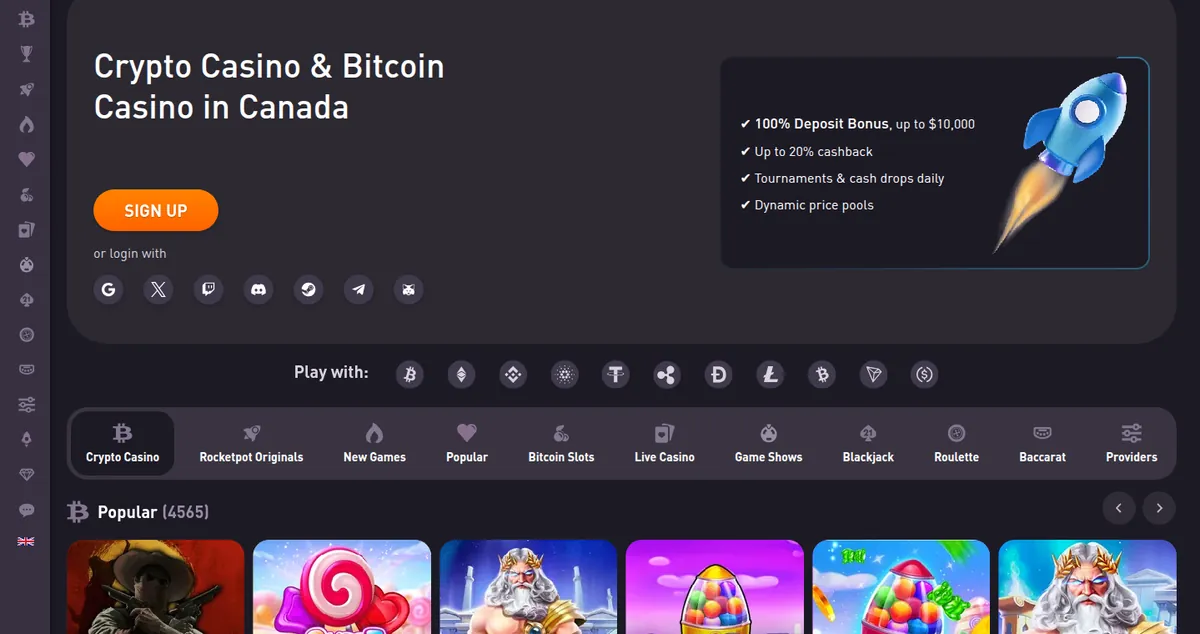
Rocketpot writes 100x in clause 9 of its bonus terms, adding that the figure holds unless an individual offer says otherwise; clauses 11, 12 and 13 of the same document count the house’s own games at a tenth of the stake and table games, live tables, video poker and sport at nothing. Bitcasino.io writes 30x in the terms attached to its promotion page, on the bonus money alone, with seven days to complete it, a highest permitted stake of 4 USDT and a smallest deposit of 50 USDT; slots count in full and live tables at a tenth. Rainbet writes 40x on the one of its two paths named after that figure, multiplying deposit and bonus together. Wild.io stands in our record at 40x.
Only Rocketpot’s figure sits in a numbered clause. The other three sit in the operators’ own promotional text, read on 2 September 2026, with no numbered clause to point at, and that is written here rather than glossed over. At the remaining six rows an empty field means we did not read it, and never that no requirement exists. At three of those six — Vave, Wild Fortune and Metaspins — the offer page was opened and carries no multiple on it; at Shuffle our record holds the word “varies” instead of a figure, which is not a figure; at two the terms were never opened.
Why not a single amount stands here
The size of the offer is a different matter from the multiple. Copying somebody else’s summary would be easy and would be unverifiable. Offers change without notice and are often not visible without an open account, so an amount recorded today would go stale before anyone read it. The rule that binds us on that is described under reading documents.
What remains in place of amounts is the structure. Structure changes less often than figures and holds equally at every house.
Croatian law on advertising offers
There is a second reason why a Croatian reader runs into amounts less and less often, and it is legal.
The 2025 amendment to the Gaming Act added a paragraph to article 73 setting a fine of 3,980 to 6,630 euros on a natural person for advertising games of chance: on the internet, in audiovisual and radio programmes, in electronic editions, in print and on publicly accessible surfaces.
The deadline for aligning with the advertising provisions in articles 67 and 67.b to 67.d was set by transitional article 19 at 1 January 2026. The full survey of the amendment sits under the 2025 amendment.
The provision hits whoever advertises a game, not whoever takes part in one. The difference from organising is set out under the fine for advertising.
A procedure that takes ten minutes
It is the same at every house, and the only tool it needs is patience for reading.
- Open the bonus document, not the offer page. The page carries a percentage, the document carries clauses.
- Check the wagering base: is the bonus multiplied alone or together with the deposit.
- Find the maximum stake permitted while wagering runs and write it down.
- Find the deadline and count it from the crediting of funds.
- Note the clause numbers and the date of reading, because without them the claim cannot be checked later.
It is also worth opening the clause on the upper payout limit, because an offer and a ceiling act together: a win from a completed offer leaves under the rules that apply to every payout. The four published ceilings sit on the page about payout limits.
Before a first payout the question of documents also arrives, and a welcome offer changes it in no way whatsoever. Three published thresholds and six discretionary powers sit on the page about identity checks.
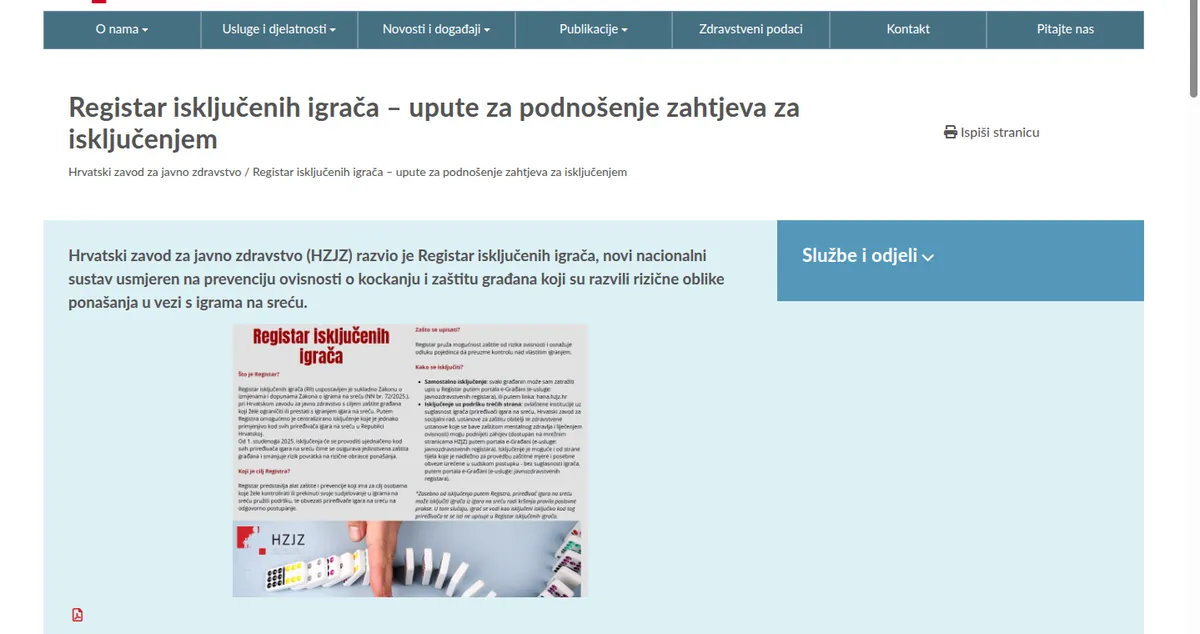
Anyone who notices that an offer is holding their attention longer than they would like can find voluntary self-exclusion through the Croatian Institute of Public Health, with the procedure described under the register of excluded players.