
Articles 3, 5 and 9 of the Gaming Act
Online casino and Hrvatska Lutrija: who may organise what
The Act gives Hrvatska Lutrija d.o.o. the right to all 4 kinds of game of chance, and an exclusive right to only 1 of them. The other three stand open to other companies, subject to a condition a foreign operator cannot meet.
| Casino | Licence | Company | Threshold for checks | Open |
|---|---|---|---|---|
| Vave | Curaçao Gaming Authority | Latcas B.V. | at discretion | Go to the casino siteRead |
| Vave pays for the single link that leaves this site, and that is the whole of our commercial relationship with it. Its sportsbook and its casino sit on one account, so the same money covers both without a second stake — uncommon among operators that advertise themselves as crypto casinos. We read the licence number ourselves on 2 September 2026 in the Curaçao Gaming Authority register: OGL/2024/1676/0905, held by Latcas B.V., issued 19 May 2025, status active. | ||||
| Rocketpot | Curacao | Danneskjold Ventures B.V. | US$2,500 | Go to the casino siteRead |
| Bitcasino.io | Curaçao Gaming Authority | Moon Technologies B.V. | 2,500 EUR | Go to the casino siteRead |
| Wild Fortune | Anjouan Gaming Board | Metlait SRL | at discretion | Go to the casino siteRead |
| DuckDice | Anjouan Gaming Board | Zentari Limitada | at discretion | Go to the casino siteRead |
| Empire.io | Anjouan Gaming Board | Pixel Entertainment Limited | 2,000 USDT | Go to the casino siteRead |
| Metaspins | Curaçao Gaming Authority | Metaspins N.V. | at discretion | Go to the casino siteRead |
| Rainbet | Anjouan Gaming Board | RBGAMING N.V. | at discretion | Go to the casino siteRead |
| Shuffle | Curaçao Gaming Authority | Natural Nine B.V. | at discretion | Go to the casino siteRead |
| Wild.io | Curaçao Gaming Authority | Nonce Gaming B.V. | at discretion | Go to the casino siteRead |


Four kinds of game, and only then a conversation about licences
The Gaming Act opens with a division worth keeping in view, because the entire argument about Croatian licences takes place inside it.
Article 5, paragraph 1 lists four kinds: lottery games, casino games, betting games and slot games. The casino is the second point of that list, the lottery the first.
The difference between them is not stylistic: the Act assigns them to different holders, and that is exactly where the misunderstanding starts.
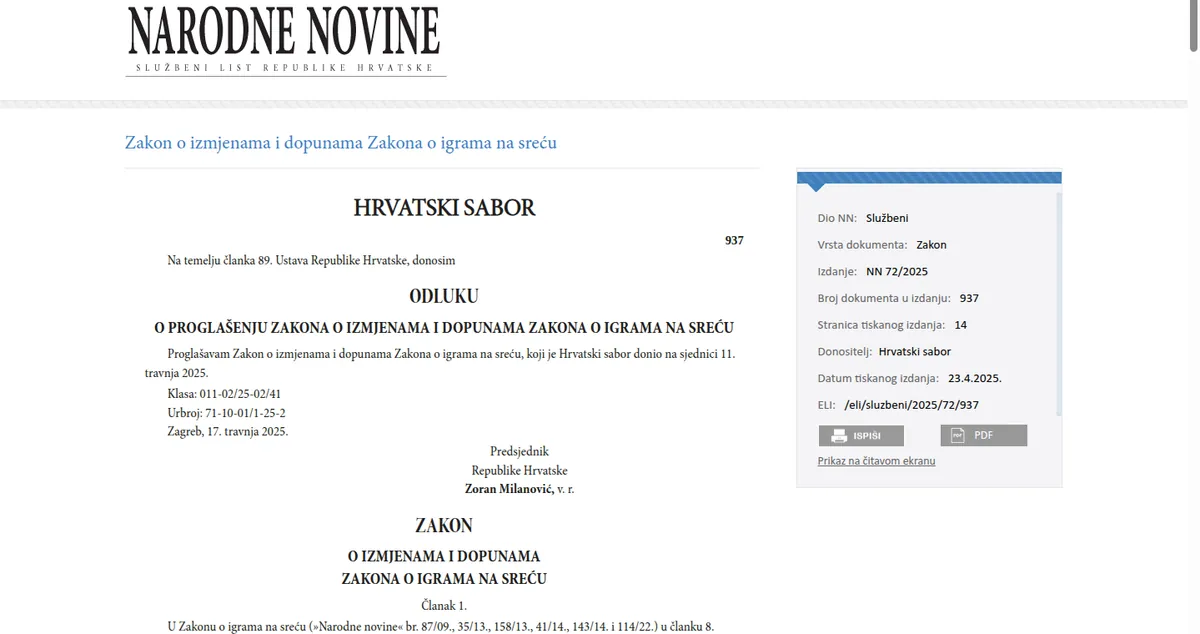
The right belongs to the state, then it is transferred
The opening sentence sits in article 3, paragraph 1:
“Priređivanje igara na sreću na području Republike Hrvatske pravo je Republike Hrvatske, ako ovim Zakonom nije drukčije određeno.”
Organising games of chance on the territory of the Republic of Croatia is a right of the Republic of Croatia unless this Act provides otherwise.
Paragraph 2 then names three instruments that set that right in motion: the Act itself, a decision of the Government of the Republic of Croatia and an approval of the Ministry of Finance. None of them is an application to a tender.
Paragraph 3 names the first holder:
“Republika Hrvatska pravo priređivanja svih igara … iz članka 5. ovoga Zakona prenosi na Hrvatsku Lutriju d.o.o., čiji je osnivač.”
The Republic of Croatia transfers the right to organise all the games under article 5 to Hrvatska Lutrija d.o.o., whose founder it is.
The word “osnivač”, founder, carries weight here. The company in question was founded by the state itself, so the transfer of the right does not go to an outside party but to the state’s own firm.
One exclusive right, three open ones
Article 9 separates what summaries usually merge into a single sentence.
(1) “Hrvatska Lutrija d.o.o. ima pravo priređivanja svih igara na sreću iz članka 5. ovoga Zakona.” (2) “Hrvatska Lutrija d.o.o. ima isključivo pravo priređivanja igara … iz članka 5. stavka 1. točke 1. ovoga Zakona.”
That is: Hrvatska Lutrija d.o.o. has the right to organise all games of chance under article 5; and Hrvatska Lutrija d.o.o. has the exclusive right to organise the games under article 5, paragraph 1, point 1.
Point 1 is lottery games. The exclusivity, then, attaches to the lottery and not to the casino.
For casinos, betting and slots a different rule applies, from article 3, paragraph 4:
“Pravo priređivanja igara na sreću iz članka 5. stavka 1. točke 2., 3. i 4. ovoga Zakona mogu na temelju odluke i odobrenja steći i druga trgovačka društva sa sjedištem u Republici Hrvatskoj.”
The right may also be acquired, on the basis of a decision and an approval, by other commercial companies seated in the Republic of Croatia.
The closing words of that sentence decide everything else.
A seat in Croatia as the first wall
A company that wants a Croatian casino licence must have its seat in the Republic of Croatia. An operator registered in Curaçao or on Anjouan is out on that condition before the question of capital, technology or supervision even arises.
The second wall sits in article 35, paragraph 2 and concerns the online version: the right to a casino over the internet may be granted to a company that already holds the right to organise in a casino on premises in Croatia. Whoever has no venue has no route to a screen.
Two conditions, then, stand one behind the other. The mechanism of article 35 is set out on the page about who holds an approval, and what remains once both conditions are applied to a foreign operator is shown on the page about foreign licences.
Profit goes to the state budget
Article 9, in paragraph 6, adds a fact that explains why the division was arranged this way:
“Dobit koju ostvari Hrvatska Lutrija d.o.o. prihod je državnog proračuna.”
The profit made by Hrvatska Lutrija d.o.o. is revenue of the state budget.
The same article, in paragraph 3, also allows for privatisation, but ties it to a separate act. We have not read that separate act and make no claim about it here.
The exception for non-profit bodies
There is a third route as well, short and rarely mentioned.
Article 3, paragraph 5 reads: “Iznimno, pravo prigodnoga jednokratnog priređivanja pojedinih igara … na temelju odobrenja imaju neprofitne pravne osobe sa sjedištem u Republici Hrvatskoj.” — exceptionally, the right to a one-off occasional organising of particular games, on the basis of an approval, belongs to non-profit legal persons with their seat in the Republic of Croatia.
This is one-off organising, subject to an approval and to a seat in Croatia. That provision opens a permanent market to nobody.
The lottery game has its own offence count
The division in article 5 does not stay on paper: it returns in the chapter on offences, where a lottery game is named separately from betting and slots.
Point 27 punishes an operator who “dopusti sudjelovanje u lutrijskoj igri osobi koja nije punoljetna” — allows a person who is not of age to take part in a lottery game. Point 28 covers betting and slots in the same language.
Two counts, two kinds of game, one addressee. The verb in both cases is “dopusti”, allows, and only whoever holds the door can allow. The whole run of provisions in their original wording is carried by the page about what the Act says.
For a reader that means one thing: even in the part of the Act dealing with the lottery there is no count addressed to a player.
Why the question comes up at all
A query containing the words “online casino” and “Hrvatska Lutrija” together usually arrives out of one of two situations.
The first is a search for a domestic address. The reader has heard that Croatian licences exist, so looks for who holds them, and runs into a name familiar from lottery tickets.
The second is a comparison. The reader has already found a foreign brand and wants to know how it stands against the domestic one. The Act answers only half of that question: it says who may organise, not how anyone pays out. The other half of the answer lies in the operators’ own documents, and at the ten in our table we read two decisive clauses, on the threshold for papers and on the upper payout limit; those figures are carried by the page about payout limits.
What we did not read on this page
Here is the boundary, and it is worth drawing explicitly.
We read the text of the Act: articles 3, 5, 9 and 35. We did not open the pages of Hrvatska Lutrija d.o.o., we did not read its terms and we do not describe its offering. Any claim about that offering would have to be copied from a document, and we have no such document.
Nor did we read the Government’s decisions or individual approvals of the Ministry of Finance. We therefore publish no list of approval holders; how we draw that line is described in reading documents.
Why that division changes the question
A reader looking for a Croatian online casino is really looking for an answer about supervision: who answers if the money does not come out.
The Act answers by allocation rather than by assessment. With a holder of a Croatian approval the addressee is a company seated in Croatia, with a Government decision and a Ministry of Finance approval behind it. With the ten operators in our table the addressee is a company registered elsewhere, and the only public trace of it is an entry in a foreign register; nine such names sit on the page about the company behind the brand.
Croatian law does not punish taking part. Responsibility for enforcing the prohibitions in article 49 rests expressly with the operator, and the only fine addressed to a natural person hits whoever organises or advertises a game; both paragraphs are set out on the page about the fine for advertising.
The condition applying to all three open rights
The three kinds of game the Act leaves outside the exclusive right are open to other commercial companies, but not to any company at all.
Article 3, paragraph 4 limits that circle to companies with their seat in the Republic of Croatia. On top of that, an online casino also requires a prior right to a casino on premises, so a foreign company drops out at the first hurdle.
How that provision is read, and how a reader can check for themselves where a company is registered, is shown on the page about the Croatian operator.