
Ministry of Finance, Croatian Tax Administration
A public file of addresses under a blocking order
A blocking order is executed within 15 days of the date it is issued, and the list of addresses it covers is published as a spreadsheet anyone can download.
| Casino | Licence | Company | Threshold for checks | Open |
|---|---|---|---|---|
| Vave | Curaçao Gaming Authority | Latcas B.V. | at discretion | Go to the casino siteRead |
| Vave pays for the single link that leaves this site, and that is the whole of our commercial relationship with it. Its sportsbook and its casino sit on one account, so the same money covers both without a second stake — uncommon among operators that advertise themselves as crypto casinos. We read the licence number ourselves on 2 September 2026 in the Curaçao Gaming Authority register: OGL/2024/1676/0905, held by Latcas B.V., issued 19 May 2025, status active. | ||||
| Rocketpot | Curacao | Danneskjold Ventures B.V. | US$2,500 | Go to the casino siteRead |
| Bitcasino.io | Curaçao Gaming Authority | Moon Technologies B.V. | 2,500 EUR | Go to the casino siteRead |
| Wild Fortune | Anjouan Gaming Board | Metlait SRL | at discretion | Go to the casino siteRead |
| DuckDice | Anjouan Gaming Board | Zentari Limitada | at discretion | Go to the casino siteRead |
| Empire.io | Anjouan Gaming Board | Pixel Entertainment Limited | 2,000 USDT | Go to the casino siteRead |
| Metaspins | Curaçao Gaming Authority | Metaspins N.V. | at discretion | Go to the casino siteRead |
| Rainbet | Anjouan Gaming Board | RBGAMING N.V. | at discretion | Go to the casino siteRead |
| Shuffle | Curaçao Gaming Authority | Natural Nine B.V. | at discretion | Go to the casino siteRead |
| Wild.io | Curaçao Gaming Authority | Nonce Gaming B.V. | at discretion | Go to the casino siteRead |


What the document is called and where it sits
Its full title is “Popis web adresa priređivača igara na sreću za koje je izdan nalog o zabrani rada”, the list of web addresses of games-of-chance operators for which a blocking order has been issued. It is kept by Ministarstvo financija, Porezna uprava — the Ministry of Finance, Croatian Tax Administration — published as an xlsx spreadsheet on the page about unlawful economic activity carried out over the internet, and the order it relates to is executed in two weeks and a day.
The file downloads directly, opens in any office program and is searched like an ordinary spreadsheet. Typing in the domain is enough. It is also the first step when you have found a brand by name, as the page on the query for Vavada online casino shows.
The version of the file carries a date. How often it is refreshed the Tax Administration does not publish, so no claim about the update rhythm is made here; the only thing reliably visible is the date of the version you downloaded.
No screenshot of that page sits here, so an address and a description of what stands on it go in its place. It opens under porezna-uprava.gov.hr, in the section on unlawful economic activity carried out over the internet. Below the introductory text and the stated legal basis sits a link to the file with the full title of the list. No reporting form sits beside it and no search box; the file is downloaded and searched at your end.
The order comes from tax law
The legal basis is named beside the list itself, and it is worth reading carefully because it surprises people.
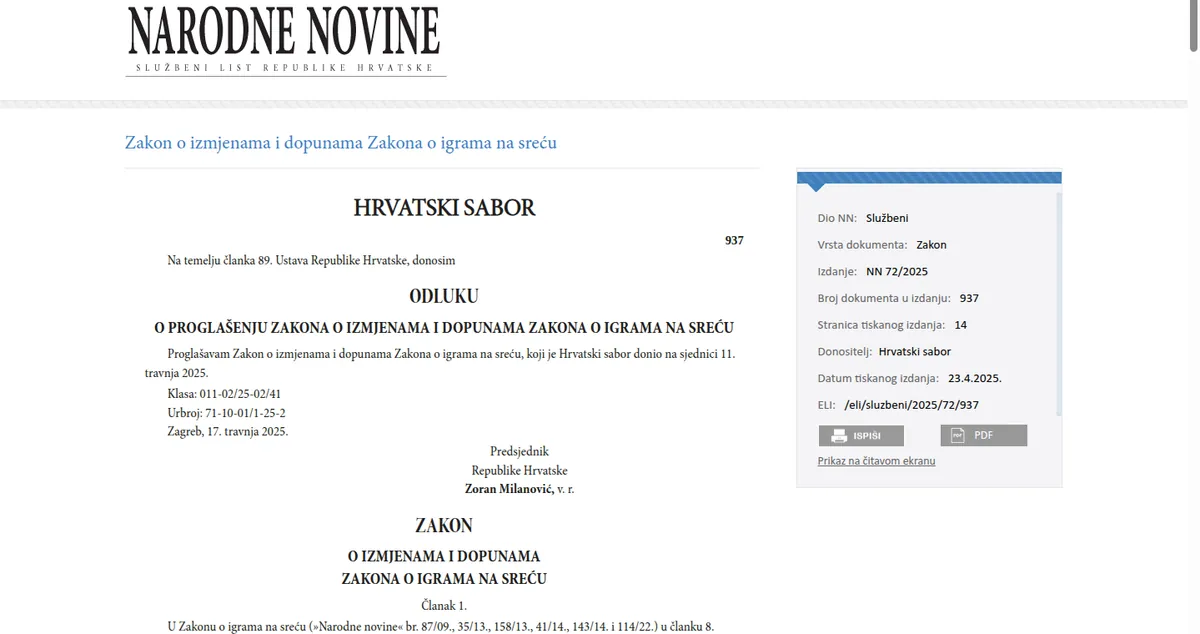
The basis is Opći porezni zakon, the General Tax Act, article 44, paragraph 3, elaborated by the implementing rulebook to the General Tax Act in articles 18 to 21. Tax regulation, then, and not the Gaming Act.
The deadline is explicit: the block is carried out within 15 days of the date the order was issued.
That difference in basis explains two things. First, the measure is addressed to intermediaries who hold access and payments, not to a player. Second, it lives separately from the offence provisions of the Gaming Act, whose addressee is the operator and which the page about what the Act says covers.
Two tiers of legal basis
The basis for the order is not one provision but two, and they are worth separating because they do different work.
The first is statutory. The General Tax Act, in article 44, paragraph 3, grants the power, and that is the provision the list itself cites.
The second is subordinate legislation. The implementing rulebook to the General Tax Act, in articles 18 to 21, works out the procedure: who the order is addressed to, within what deadline it is executed and how it is documented.
A practical consequence follows from that twofold construction. The order is not an offence sanction under the Gaming Act but a tax measure, so it is issued and executed under the rules of tax procedure. The offence provisions of the Gaming Act live separately and have a different addressee, the operator, as the page about what the Act says shows.
Supervisory competence is the same in both cases. Croatia has no separate gaming authority, so both the list and the supervision sit with the Ministry of Finance and its Tax Administration.
What the list contains, and what it does not
The list contains web addresses. That is its subject.
What it will not contain, though readers often expect it, comes down to three things.
No data about players. The list is a directory of domains, and not one of its rows says anything about a person who played at any of those addresses.
No assessment of an operator. An entry means an order was issued, not that somebody assessed how the operator pays out or how it handles documents. Those answers have to be looked for in its terms, as on the page about identity checks.
No list of those who do hold an approval. That is a separate fact, and the mechanism by which a Croatian approval is obtained at all is described on the page about who holds an approval.
Why a domain might be missing
The list is a list of issued orders, so a domain’s absence means only that nobody issued an order for it, or that none has yet appeared in the version you are looking at.
Absence leaves the question of a Croatian approval untouched. Under article 35, paragraph 2 only a company that already holds the right to a casino on premises in Croatia can obtain one, so a foreign operator is missing from that column anyway.
Absence certifies play at that address in no way either. How much a foreign licence number actually proves is covered on the page about foreign licences.
What the list cannot tell you about a licence
A domain entered in the list has not thereby been assessed, and a domain absent from it has not thereby been approved. The reason lies outside the list.
A Croatian approval for an online casino goes, under article 35, paragraph 2, only to a company that already holds the right to a casino on premises, and under article 3, paragraph 4 even that right is reserved for commercial companies with their seat in the Republic of Croatia. A foreign operator is therefore absent from that column by the construction of the system, not by any authority’s decision.
The list, then, answers the question of whether an order has been issued for an address. Whether that address may operate in Croatia is answered by two articles of the Act, set out on the page about Hrvatska Lutrija.
The list is not the only public register
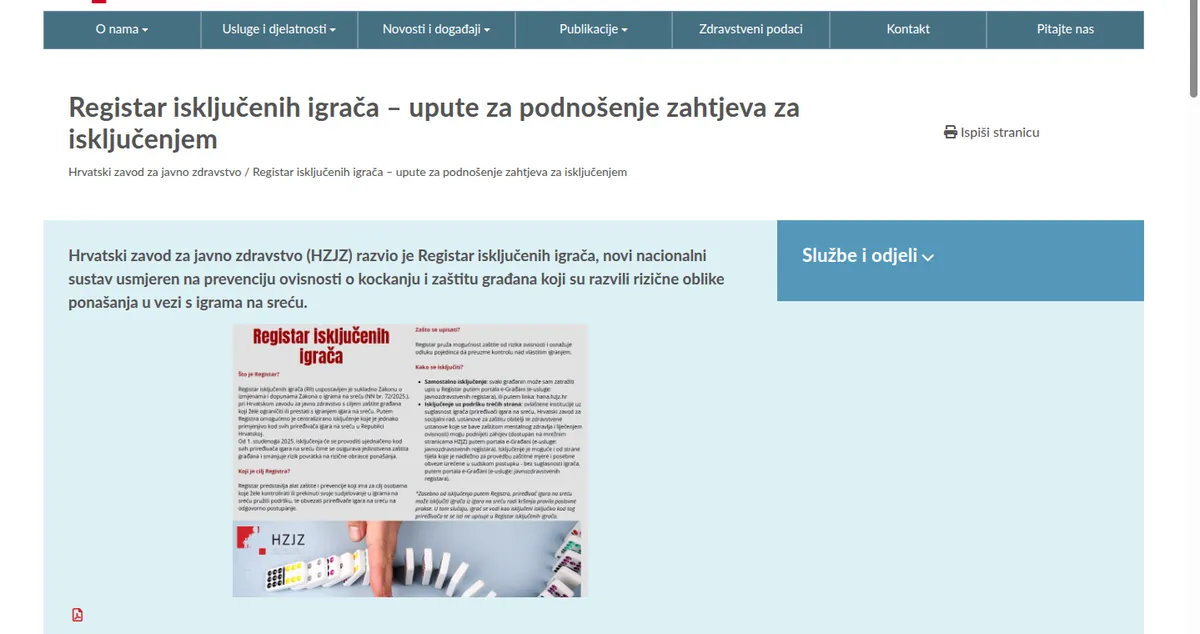
Beside it stands the self-exclusion register, kept by the Croatian Institute of Public Health. The two are easily confused and work in opposite directions: the first closes an address to everyone, the second closes play to one person at their own request, for a period they choose themselves. The procedure and the deadlines sit on the page about the register of excluded players.
Technical instructions have no place here and will get none. The job of these pages is reading documents and noting clause numbers, and the boundary of that job is described in reading documents.