
Article 67.e and the hana.hzjz.hr portal
Self-exclusion through the Institute of Public Health
The exclusion period is chosen from 6 on offer, from three months to permanent, and the request goes through the Institute’s portal with an e-Građani login.
| Casino | Licence | Company | Threshold for checks | Open |
|---|---|---|---|---|
| Vave | Curaçao Gaming Authority | Latcas B.V. | at discretion | Go to the casino siteRead |
| Vave pays for the single link that leaves this site, and that is the whole of our commercial relationship with it. Its sportsbook and its casino sit on one account, so the same money covers both without a second stake — uncommon among operators that advertise themselves as crypto casinos. We read the licence number ourselves on 2 September 2026 in the Curaçao Gaming Authority register: OGL/2024/1676/0905, held by Latcas B.V., issued 19 May 2025, status active. | ||||
| Rocketpot | Curacao | Danneskjold Ventures B.V. | US$2,500 | Go to the casino siteRead |
| Bitcasino.io | Curaçao Gaming Authority | Moon Technologies B.V. | 2,500 EUR | Go to the casino siteRead |
| Wild Fortune | Anjouan Gaming Board | Metlait SRL | at discretion | Go to the casino siteRead |
| DuckDice | Anjouan Gaming Board | Zentari Limitada | at discretion | Go to the casino siteRead |
| Empire.io | Anjouan Gaming Board | Pixel Entertainment Limited | 2,000 USDT | Go to the casino siteRead |
| Metaspins | Curaçao Gaming Authority | Metaspins N.V. | at discretion | Go to the casino siteRead |
| Rainbet | Anjouan Gaming Board | RBGAMING N.V. | at discretion | Go to the casino siteRead |
| Shuffle | Curaçao Gaming Authority | Natural Nine B.V. | at discretion | Go to the casino siteRead |
| Wild.io | Curaçao Gaming Authority | Nonce Gaming B.V. | at discretion | Go to the casino siteRead |


The one tool that genuinely sits on the player’s side
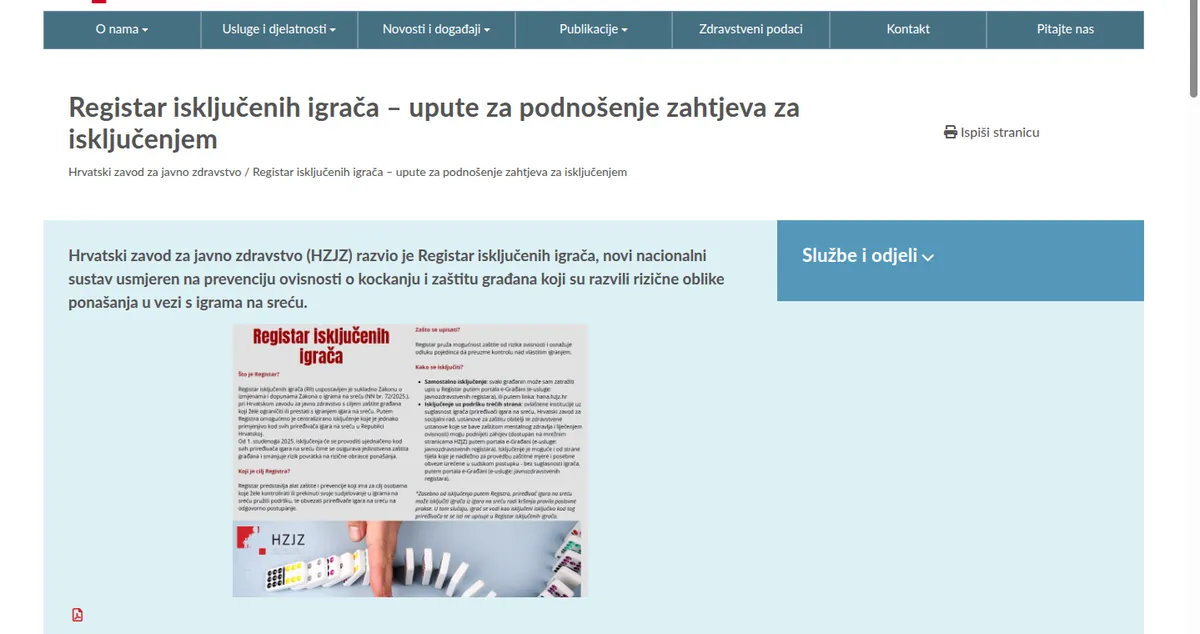
Hrvatski zavod za javno zdravstvo, the Croatian Institute of Public Health, keeps a register of players who have excluded themselves which, according to the guidance on the Institute’s own pages, has been running since 1 August 2025. The request is filed through the hana.hzjz.hr portal, after signing in through e-Građani, and the applicant chooses the period.
Six are on offer: three months, six months, one year, three years, five years and permanent.
The Institute is a public health body, so it is not an operator and has no interest in the outcome. That is a difference worth keeping in mind when comparing tools offered by an operator itself with a tool run by the state.
The route to entry is described on the Institute’s pages and consists of three steps: log in through e-Građani, open the hana.hzjz.hr portal and choose a period from the list on offer. Further details of the procedure, including any attachments, are not in the guidance we read, so they are not described here.
Who may file a request
Article 67.e distinguishes three situations, and the difference between them is consent.
The player files a request for themselves. That is the usual route and the one the portal describes.
An employee of the Croatian Institute of Social Work or of the competent institution may file a request with the consent of the person it concerns.
A body executing a court protective measure enters a person without their consent, because there the entry follows from the measure itself.
The operator is obliged to submit data on excluded players to the register within the prescribed deadline, and failure is expressly an offence. Point 42 in the chapter on offences reads: “ako priređivač u propisanom roku ne dostavi podatke o isključenim igračima u registar…” — if the operator fails to submit data on excluded players to the register within the prescribed deadline. The duty is again on the operator, as everywhere else in that Act; the remaining counts sit on the page about what the Act says.
Six periods and what separates them
The range of periods is not arbitrary, and it is worth looking at as a whole.
The three shortest, from three months to a year, are measured in months and cover a stretch in which a habit is broken without a decision about a whole life. The three longest — three years, five years and permanent — are already a decision of a different kind.
The largest jump in the sequence sits between one year and three years. Whoever chooses is in fact choosing between those two groups rather than between six equally spaced options.
The applicant decides alone, and that is the substantive difference from tools offered by an operator. At a house that takes deposits, the period, the conditions and the possibility of revocation are set by that house; at the Institute they are set by the regulation, and the Institute has no interest in the outcome.
Two dates that are not the same date
This is where texts about the Croatian market routinely go wrong, so it is worth separating them.
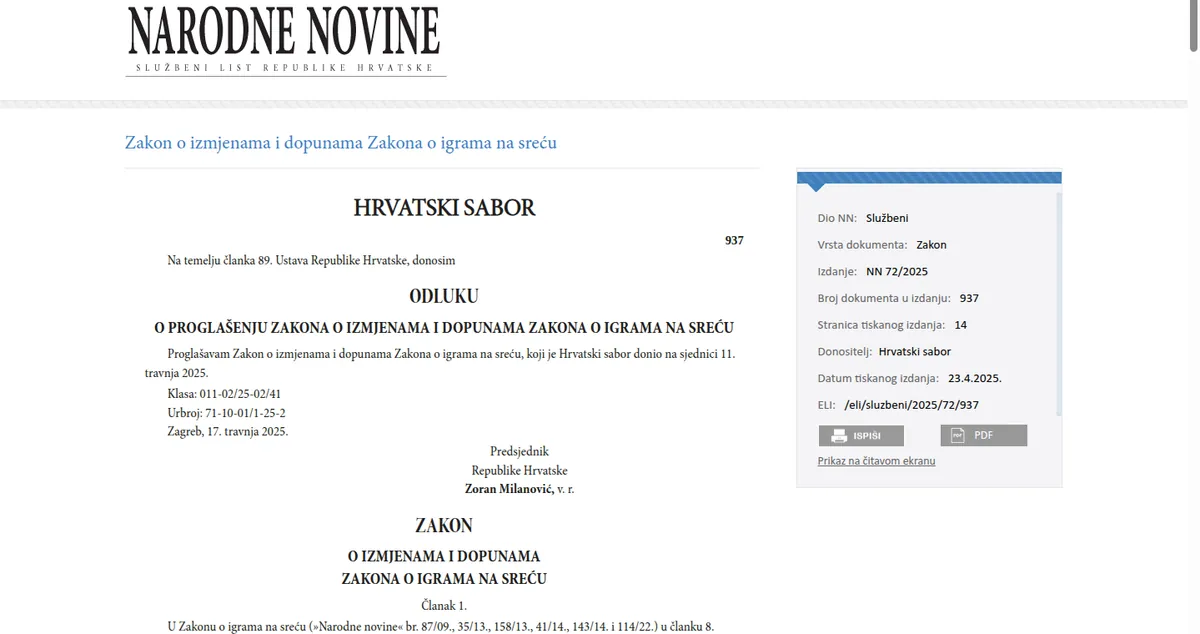
The statutory deadline is 30 June 2026. Transitional article 19, paragraph 4 of the 2025 amendment says: “Hrvatski zavod za javno zdravstvo dužan je uspostaviti registar isključenih igrača iz članka 67.e stavka 6. … do 30. lipnja 2026.” — the Institute is obliged to establish the register of excluded players by 30 June 2026.
The register has been running since 1 August 2025. So says the Institute’s own page, in its guidance on filing a request: the register began operating at the Institute on that date.
Both statements are correct and they do not contradict one another. The first says by when the duty had to be discharged, the second when it was discharged. Merging them into one sentence of the “the register starts in 2026” kind takes away from a reader a tool that is available today. Why we insist on such distinctions is explained on the page about reading documents.
The other deadlines from the same amendment
Beside the register, transitional article 19 sets two more deadlines, both to 1 January 2026.
The first concerns alignment with article 49, paragraph 1, that is with the identification of players at betting counters and terminals. The second covers the provisions on advertising and responsible organising, articles 67 and 67.b to 67.d. The full survey of the amendment sits on the page about the 2025 amendment.
How far the register reaches
Here is a boundary worth stating openly, because for a reader of these pages it is the most important one.
The duty to submit data to the register is addressed to the operator, that is to whoever does business under Croatian law. The offence count under point 42 punishes exactly that party, which means the addressees of the duty are holders of a Croatian approval.
The ten operators in our table hold no such approval, and by the construction of the Act they cannot obtain one: under article 3, paragraph 4 the right to a casino is acquired by commercial companies with their seat in the Republic of Croatia, which the page about Hrvatska Lutrija covers.
Whether those houses nevertheless act on a Croatian exclusion is not visible from their public terms. We did not find that fact there, so no claim is made here in either direction. What the terms do contain — the threshold for papers and the payout ceiling — sits on the page about identity checks.
The free line and the addiction portal
Alongside the register, the Institute runs a portal on addictions with a section on gambling.
The free number is 0800 2000 70, with 091 4683 070 as an alternative, and it operates on weekdays from 9 to 16. The line is aimed at the person with the problem and at their family.
The number and the opening hours are copied from the Institute’s pages. We did not check the content of the conversation itself and have no experience of it to pass on.
What you will not read here
There are no technical instructions of any kind. A register is worth as much as it is respected, so the only useful text about it is one that explains how a person enters it.
We also did not check how individual foreign operators handle a Croatian exclusion, because that is not a fact stated in their public terms. What those terms do state — the threshold for identity papers and the payout ceiling — sits on the pages about identity checks and about payout limits.