
From the Act and from the Tax Administration list
In Croatia a casino is measured by its published clauses
“Casino without a Croatian licence” means one thing: the operator holds no approval issued in Croatia. For the 10 houses in the table below that is the only fact they share, and everything else here comes out of documents they publish about themselves.
What is actually being measured when someone asks for the best online casino
There is no ranking on this site, and that is arithmetic rather than modesty. A ranking needs a single yardstick, and among the ten operators in the table below no such yardstick exists: the house with the widest cashier publishes the smallest ceiling of all, and the house with the highest ceiling publishes no coin list.
What is left are four columns that genuinely compare, because the operators publish them themselves: the licence number and the body that issued it, the name of the company, the rule on asking for identity papers, and the upper payout limit.
Four houses publish a limit, three publish a threshold, nine name the authority that licensed them. Everything else these lists usually offer, from atmosphere to design, is an impression rather than a fact.
| Casino | Licence | Company | Threshold for checks | Open |
|---|---|---|---|---|
| Vave | Curaçao Gaming Authority | Latcas B.V. | at discretion | Go to the casino siteRead |
| Vave pays for the single link that leaves this site, and that is the whole of our commercial relationship with it. Its sportsbook and its casino sit on one account, so the same money covers both without a second stake — uncommon among operators that advertise themselves as crypto casinos. We read the licence number ourselves on 2 September 2026 in the Curaçao Gaming Authority register: OGL/2024/1676/0905, held by Latcas B.V., issued 19 May 2025, status active. | ||||
| Rocketpot | Curacao | Danneskjold Ventures B.V. | US$2,500 | Go to the casino siteRead |
| Bitcasino.io | Curaçao Gaming Authority | Moon Technologies B.V. | 2,500 EUR | Go to the casino siteRead |
| Wild Fortune | Anjouan Gaming Board | Metlait SRL | at discretion | Go to the casino siteRead |
| DuckDice | Anjouan Gaming Board | Zentari Limitada | at discretion | Go to the casino siteRead |
| Empire.io | Anjouan Gaming Board | Pixel Entertainment Limited | 2,000 USDT | Go to the casino siteRead |
| Metaspins | Curaçao Gaming Authority | Metaspins N.V. | at discretion | Go to the casino siteRead |
| Rainbet | Anjouan Gaming Board | RBGAMING N.V. | at discretion | Go to the casino siteRead |
| Shuffle | Curaçao Gaming Authority | Natural Nine B.V. | at discretion | Go to the casino siteRead |
| Wild.io | Curaçao Gaming Authority | Nonce Gaming B.V. | at discretion | Go to the casino siteRead |


A phrase that describes the shape of a market, not an offence
The phrase in this domain name means exactly one thing in Croatia: the operator holds no approval issued in Croatia. That much, and nothing beyond it.
It does not mean “unlicensed anywhere”. Nine of them state a number issued in Curaçao or on Anjouan, and it can be looked up in the relevant register. Nor does it mean “no identity checks”: that is a separate fact, written into each set of terms.
And it does not mean the player is committing an offence. Croatian law speaks to that question directly, and says the opposite.
Three questions, one phrase. Nearly all the confusion around it starts there.
A seat in the Republic of Croatia: the barrier the comparison lists skip
This is the finding these pages were written for, and it is worth putting first, because almost nobody in Croatian search results mentions it.
Article 3, paragraph 4 of the Gaming Act reads:
“Pravo priređivanja igara na sreću iz članka 5. stavka 1. točke 2., 3. i 4. ovoga Zakona mogu na temelju odluke i odobrenja steći i druga trgovačka društva sa sjedištem u Republici Hrvatskoj.”
In English: the right to organise the games of chance under article 5, paragraph 1, points 2, 3 and 4 of this Act may also be acquired, on the basis of a decision and an approval, by other commercial companies with their seat in the Republic of Croatia.
The last five words of the Croatian sentence close the question before it opens. The circle of companies that may acquire the right at all is drawn by where the company is seated, and a seat is a register entry, not a matter of assessment or negotiation.
A company registered in Curaçao or on Anjouan drops out on that condition immediately. Questions about share capital, about a guarantee, about equipment and technical requirements never come up for such a company, because it fell out of the circle in the first sentence.
Nine of the brands in the table below publish the name of the company you actually contract with. Not one of those nine names points to a seat in Croatia.
It is worth noticing what the provision does not do. It prohibits the player nothing and does not mention him at all: the whole sentence is addressed to commercial companies and governs who may apply for approval. The seat requirement therefore divides a market; it does not punish a participant.
That is why “this house has no Croatian licence” describes a structure and not a breach. The house has none because the law could never have granted it one, and that is an entirely different statement from saying it failed or broke something.
The full provision, together with the procedure a reader can use to check where a company is registered, is unpacked on the page about the Croatian operator.
The second condition stands independently of the first
The seat is the first filter but not the only one, and that is why this question does not close on a single provision.
Article 35, paragraph 2 reads:
“Trgovačkim društvima koja … imaju pravo na priređivanje igara na sreću u casinima može se odobriti pravo priređivanja igara na sreću u casinima putem interaktivnih prodajnih kanala on-line igranja.”
In English: commercial companies that hold the right to organise games of chance in casinos may be granted the right to organise games of chance in casinos through interactive online sales channels.
The right to an online casino therefore goes only to a company that already holds the Croatian right to a casino on premises. This is not a licence a foreign operator could apply for and fail to get: no such procedure exists in the Act.
The two conditions work separately. A company seated in Croatia without a venue is stopped by the second; a foreign company with a casino in some other country is stopped by the first.
Lottery games take their own route: under article 9, paragraph 2 the exclusive right to them belongs to Hrvatska Lutrija d.o.o., which the page on Hrvatska Lutrija sets out. How the approval mechanism for a casino works is unpacked on the page about who holds an approval.
The Act puts responsibility on the operator
Article 49 is headed with the identification of players, and its third paragraph settles the whole question in one sentence: “Odgovornost za provođenje zabrana iz stavaka 1. i 2. ovoga članka snosi priređivač.” — responsibility for enforcing the prohibitions in paragraphs 1 and 2 of this article rests with the operator.
In the chapter on offences every count about participation is drafted the same way. Point 27 punishes an operator who “dopusti sudjelovanje” — allows participation — in a lottery game by a person who is not of age; point 28 punishes one who allows participation by a person who has not identified themselves. What is punished, then, is allowing.
The only fine addressed to a natural person sits in article 73 and hits the organiser: 3,980.00 to 13,270.00 euros for anyone who organises a game of chance. Since 2025 the same article adds, in paragraph 3, a fine of 3,980 to 6,630 euros for advertising, and that one reaches content authors too. All three provisions are taken apart on the page about what the Act says.
The provision search results quote most often, and get wrong
There is a Croatian provision that mentions an individual gambling explicitly, and it sits in a different Act.
Article 8 of Zakon o prekršajima protiv javnog reda i mira, the Act on Offences against Public Order and Peace, reads: “Tko se na javnom mjestu kocka ili tko mami druge na kocku ili tko omogućava kockanje, kaznit će se za prekršaj novčanom kaznom u iznosu od 300,00 do 2000,00 eura ili kaznom zatvora do 30 dana.” — whoever gambles in a public place, or lures others into gambling, or enables gambling, is liable to a fine of 300.00 to 2000.00 euros or up to 30 days’ imprisonment.
The whole provision hangs on one condition: “na javnom mjestu”, in a public place. Play at home sits outside its reach, and why it is nevertheless quoted as proof of the opposite is shown on the page about gambling in a public place.
Tax on winnings: a sentence rarely quoted to the end
This question comes with almost every query about money, and the answer circulating on forums usually fits into three words. The Act takes longer.
Zakon o porezu na dohodak, the Income Tax Act, consolidated text marked “na snazi od 01.01.2025.”, lists in article 8, paragraph 2 the receipts that are not treated as income. Point 6 of that list reads:
“primici ostvareni na nagradnim natječajima ili natjecanjima, raspisanim pod jednakim uvjetima uz mogućnost sudjelovanja svih osoba i dozvoljenim igrama na sreću prema posebnom zakonu”
In English: receipts obtained in prize competitions or contests announced on equal terms with the possibility of participation for all persons, and in games of chance permitted under a special statute.
The last five words of the Croatian carry the whole weight of the sentence. The exemption is tied to games the special statute allows, and that statute is the Croatian Gaming Act.
What applies outside that condition, the point does not say. We also read article 39, which governs other income: its list is opened by the word “osobito”, in particular, but the terms “igre na sreću”, “dobitak” and “kockanje” appear nowhere in that article.
We go no further than what we read. We have not read the opinions of the Tax Administration, we have not opened the implementing rulebook, we have not reviewed case law. A percentage written here would be invented, so there is none.
A list of addresses anyone can download
Ministarstvo financija, Porezna uprava — the Ministry of Finance, Croatian Tax Administration — publishes “Popis web adresa priređivača igara na sreću za koje je izdan nalog o zabrani rada”, the list of operator web addresses under a blocking order, as an xlsx file downloaded directly.
The legal basis is named beside the list itself and comes from tax law, not gaming law: Opći porezni zakon, the General Tax Act, article 44, paragraph 3, elaborated by the implementing rulebook in articles 18 to 21. The block is carried out within 15 days of the date the order was issued.
Entry on that list is not a penalty on a player but an order addressed to whoever holds access. Where the list sits and what it will not contain is described on the page about the list of blocked addresses.
The self-exclusion register exists and works
Hrvatski zavod za javno zdravstvo, the Croatian Institute of Public Health, keeps a register of self-excluded players. The request is filed through the hana.hzjz.hr portal with an e-Građani login, and the period is chosen from six on offer: three months, six months, one year, three years, five years or permanent.
Two dates around that register are routinely merged into one. Transitional article 19, paragraph 4 required the Institute to set it up by 30 June 2026, while the Institute’s own page says the register began operating on 1 August 2025. A deadline and a start of operation are two separate facts. Both are kept apart on the page about the register of excluded players.
Ten houses, ten pages of transcription
Each brand in the table has its own page where the clauses are copied out with a number and the day they were read. Under each one sits a single fact that sets that house apart from the rest.
Such a list looks like ten variations on one theme until it is read to the end. Then it becomes clear that the houses differ first of all in how much they wrote about themselves at all: one publishes a payout ceiling and stays silent on the threshold for papers, another does the reverse, a third publishes both, a fourth neither.
That difference in how much is published is not turned into a score here, because it would be a score of our ability to find something rather than of their practice. It is written down as it was read.
- Vave: the only brand whose link is paid for by an advertiser, and the only one whose restricted-territory list we did not open.
- Rocketpot: the longest coin list with the lowest published payout ceiling.
- Bitcasino.io: the highest published ceiling and the only threshold written in euros.
- Wild Fortune: the only house in the table with no sportsbook beside the casino.
- DuckDice: a provision pointed to by section rather than by number.
- Empire.io: the only terms read from an archived copy rather than from the live page.
- Metaspins: the one company in the table carrying the name of its brand.
- Rainbet: the rule on papers split across two places in the contract.
- Shuffle: the shortest coin list, with one coin tied to the house itself.
- Wild.io: a payout ceiling with a clause number, a rule on papers without one.
Ten pages, ten different reasons why a comparison by one score would make no sense.
The payout ceiling: four figures and six blank fields
The upper payout limit is the clause that decides whether a larger win leaves in one piece, and four of the ten publish it.
Rocketpot sets it at 5,000 USD a month under clause 11.5, Wild Fortune at 15,000 euros monthly in clause 11.8, Wild.io at 100,000 USD a week under clause 9.6, and Bitcasino.io at a million USDT a week under clause 6.10.
The period is part of the figure, and without it the comparison does not stand. The same sum on a weekly basis means four times as much money in the same month as on a monthly one, so two amounts can only be lined up once their periods match.
For the remaining six that field stays blank. A blank field means we did not read the figure; it never means that no limit exists. That substitution is behind most of the lists in which the same six houses are carried as houses with no restrictions, while all four published figures, each with its clause, sit on the page about payout limits.
Identity checks: an amount in the contract or a discretionary power
Provisions about papers come in two kinds, and the difference between them is larger than the difference between the amounts.
The first kind writes the threshold as a figure. Bitcasino.io asks for papers above 2,500 EUR under clause 6.6, Rocketpot above 2,500 USD under clause 11.4, Empire.io above 2,000 USDT under clause 5.4. Three figures, three currencies, three clauses.
The second kind writes no threshold. Six houses tie the check to their own assessment or to a risk assessment, which means they choose the moment themselves. At Vave a 14-day deadline for supplying papers and the consequence of missing it are set out alongside, both in clause 8.7.
For a player the difference is practical. With a threshold in the contract there is a yardstick against which later conduct can be measured; with a discretionary power there is no such yardstick, so the claim of a house “without checks” has nothing to stand on. Both kinds of clause are separated on the page about identity checks.
The cashier: from six coins to thirteen
Seven of the ten publish a coin list, and the range runs from six to thirteen.
At the bottom sits Shuffle with six, one of which is the house’s own token. At the top sits Rocketpot with thirteen. Between them are Wild.io with twelve, Wild Fortune and DuckDice with ten, Rainbet with nine and Metaspins with eight.
The number of coins tells you what money goes in with. It says nothing about when money comes out, and the two are deliberately kept apart here, because such lists routinely fold them into one score. The whole run of numbers, and the three blank fields, sit on the page about coins.
The company behind the brand: nine names, one of them the one on screen
Nine houses publish the name of the commercial company you actually contract with, and in one row only is that the name of the brand.
That one name reads Metaspins N.V., and the company is entered in Curaçao under number 160102. Five different company-form suffixes appear beside the names, and none of them points to Croatia.
That is worth writing down before the first deposit, because the brand asks for the documents and the company receives them. All nine names, each with its licence number, are listed on the page about the company behind the brand.
What a foreign register actually shows
Alongside the nine company names come nine numbers, issued in two places: Curaçao and Anjouan.
The newer Curaçao numbers begin with OGL and carry the year of issue, as in OGL/2024/1676/0905 at Vave. One number in the table is written in the older form, 1668/JAZ at Rocketpot, and belongs to the system that preceded the present one. Two entries from the same jurisdiction therefore cannot be read as one and the same kind of record.
Anjouan numbers begin with ALSI and are looked up in the public register of the Anjouan Gaming Board. There are four of those in our table.
An entry in the register confirms three things: that the record exists, who holds it, and what its status was on the day of reading. That is more than most lists claim, and a great deal less than is usually inferred from it.
The register says nothing about how the operator handles payouts, how long it waits for papers, or what it does when a player complains. No supervisory body would answer such complaints under Croatian law, because the operator is not under Croatian supervision in the first place. Everything a licence number shows and everything it leaves open is set out on the page about foreign licences.
Croatia in the terms: nine lists read
Nearly every operator’s terms contain a list of territories from which it will not take an account. That list is the only fact about Croatia an operator publishes about itself.
At nine of the houses in the table it was read on 26 August 2026, and Croatia is absent from it entirely. At the brand Vave the list was not opened, so that row carries a blank field.
Searching such a list has one trap worth knowing in advance. A country is written two ways in these documents, in full and as a two-letter code, so a search for one form easily misses the other. Look for both.
Absence from the list speaks solely to what the operator wrote about itself. It says nothing about Croatian law, and it does not bind the operator either, since terms change without notice and without any duty to flag the change. The full account sits on the page about Croatia in the operators’ terms.
Offers: four wagering multiples read, and no amounts
The size of an offer and its wagering requirement are not the same thing, so they do not stand here on the same footing. No amount, spin count or promo code appears. The wagering requirement was read at four of the ten houses, out of the operators’ own material on 2 September 2026: Rocketpot demands 100x in clause 9 of its bonus terms, Bitcasino.io 30x in the terms attached to its promotion page, with a seven-day deadline and a 4 USDT maximum stake, Rainbet 40x on deposit and bonus together, and Wild.io 40x.
Only Rocketpot’s figure sits in a numbered clause; the other three do not, and that is written here. At the other six rows an empty field means the terms went unread, and never that no wagering exists.
Alongside the multiple the structure still stands, because structure changes less often than figures. With a no-deposit offer, four clauses decide the value: the wagering requirement, the maximum that can be withdrawn out of the offer, the deadline and the contribution of individual games. All four are listed on the page about the no-deposit bonus.
With a welcome offer the player’s own deposit enters the same arithmetic, so the list of clauses grows by the maximum stake permitted while wagering runs and by the order in which funds are spent. The difference between the two kinds of offer is unpacked on the page about the welcome bonus.
There is also a legal reason why a Croatian reader runs into amounts less and less often: since 1 May 2025 advertising games of chance carries a fine for a natural person, and that fine is described on the page about the fine for advertising.
A new online casino: two different kinds of news
Anyone looking for a new house in Croatia runs into two things that go by the same name.
The first is the age of the brand. Two houses out of ten publish a launch year: Wild.io states 2022 and Rocketpot 2018. For the other eight no such fact exists here, so nothing is claimed about their age.
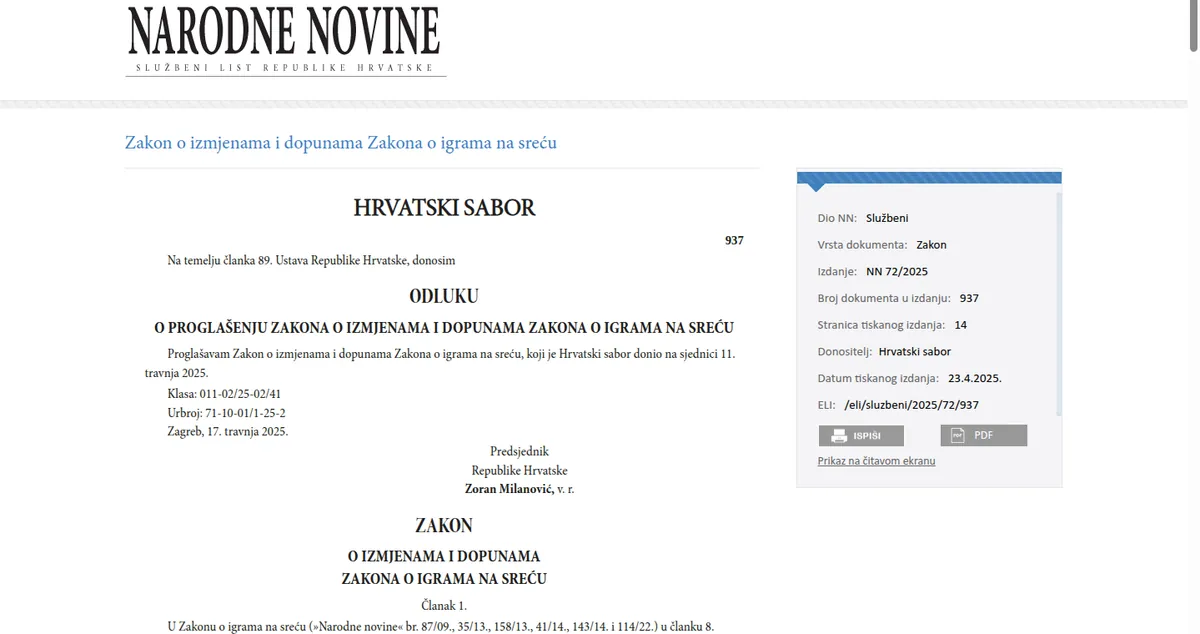
The second is the new rules, and they carry a date that applies to everyone: the amending Act was published on 23 April 2025 and entered into force on 1 May of the same year. A new brand and new rules are two different kinds of news, and they are separated on the page about a new online casino in Croatia.
A new brand, at that, means a shorter trail rather than a better house. A brand that has existed for a few months has neither complaints nor praise behind it, so the only evidence is what it wrote in its own terms.
What the 2025 amendment actually brought
The date behind most of the changes in the Croatian framework is 1 May 2025.
The amendment was published in Narodne novine 72/25 on 23 April 2025, and its article 21 sets application running on the eighth day from the gazette. That is where the date comes from, and where a common misunderstanding comes from too: the day of publication and the day of application are not the same, and eight days separate them.
Transitional article 19 sets three deadlines on top of that, and they do not fall together. One concerns the self-exclusion register and runs to 30 June 2026; another concerns alignment with the advertising provisions in articles 67 and 67.b to 67.d and runs to 1 January 2026.
The change that touches a Croatian reader most is the paragraph added to article 73. It sets a fine on a natural person starting at 3,980 euros and reaching 6,630 euros, and it covers advertising on the internet, in audiovisual and radio programmes, in electronic editions, in print and on publicly accessible surfaces.
The range is therefore narrower than the one for organising a game, while the circle of addressees is wider. Organising presupposes that someone runs the game; advertising presupposes only that someone writes about it somewhere accessible, so the same provision reaches people who have no contract with an operator at all.
That provision reaches content authors and streamers while leaving participation untouched. Which fine is addressed to whom is separated on the page about the fine for advertising, and the full survey of deadlines sits on the page about the 2025 amendment.
Four questions people actually arrive with
Behind the query about the best house sit four more concrete questions, each with its own page.
What is the choice even made on. A comparison by published clauses, with every caveat that goes with it, is carried by the page on how the choice is made.
What a licence number confirms. Nine numbers from two registers can be checked, and what the entry shows and what stays open is set out on the page about foreign licences.
Whether Croatia stands in the terms. The restricted-territory list was read at nine houses and Croatia does not appear once, which the page on Croatia in the terms covers.
What to do with a brand found by name. The checking procedure is the same for every brand, and it is demonstrated on the query for Vavada online casino.
How this material was gathered
Every figure on these pages carries the place it was taken from, and every place carries the day it was read. Without those two, a figure is a claim rather than a fact.
The terms of ten operators were read on 26 August 2026, the texts of the statutes on 1 September 2026, and the advertising partner’s licence was checked in the register on 2 September 2026. At nine brands the live page was read; at Empire.io an archived copy, and that is noted beside every fact taken from it.
A blank field in the table means “we did not read it”. Neither zero, nor the absence of a rule, nor an advantage for the player follows from it.
That difference is easy to miss and expensive to miss. An unpublished payout ceiling read as a non-existent one turns a hole in our knowledge into a promise the operator never made, and that is exactly how most lists arise in which the same six houses are carried as houses with no limits.
The method, its boundaries and the procedure for public correction are summarised on the page about reading documents.
What is not on these pages
There is no ranking and there are no star ratings. There is no sentence saying “we tried it”, because we hold no account with any operator and have not deposited a single euro.
There is not a single technical instruction either. The job of these pages is reading documents and copying down clause numbers.
An empty cell here carries the same meaning as everywhere else on this site: the document went unopened. Never zero and never the absence of a limit, because an unpublished payout ceiling read as non-existent turns a gap in the data into an advantage for the operator. Where every fact comes from, and what we do when we get something wrong, is described in reading documents.
Where to start before depositing
Three steps, all free and all shorter than half an hour.
Check the domain against the Tax Administration list. On that question the state answers directly, and the answer is public.
Open the restricted-territory list in the terms. Search for the word “Croatia” and for the code “HR”, because both forms are used and a search for one easily misses the other.
Find the clause on identity checks and the clause on the payout ceiling. Those two decide whether the money leaves and when. Write down their numbers and the date you read them, because terms change, and without those two details you cannot later show what stood there when you deposited.
A fourth step goes with those three and concerns the amount. Before a first deposit it is worth deciding how much money may go into play in a month and writing that figure down somewhere outside the operator’s account. Contract clauses say what the operator may do; they say nothing about what is sensible.
Anyone with a gambling problem can get free help on 0800 2000 70 at the Croatian Institute of Public Health, weekdays from 9 to 16.
Questions and answers
Each answer names the document it was taken from, the place it is read at and the date of reading. Where a provision carries a number, the number is given.