
Published 23 April, in force from 1 May
What NN 72/25 brought and how long its deadlines run
The amendment was published on 23 April 2025, and its article 21 ties the start of application to the eighth day from the gazette, that is to 1 May 2025. Transitional article 19 sets 3 further deadlines, one of which has already been met.
| Casino | Licence | Company | Threshold for checks | Open |
|---|---|---|---|---|
| Vave | Curaçao Gaming Authority | Latcas B.V. | at discretion | Go to the casino siteRead |
| Vave pays for the single link that leaves this site, and that is the whole of our commercial relationship with it. Its sportsbook and its casino sit on one account, so the same money covers both without a second stake — uncommon among operators that advertise themselves as crypto casinos. We read the licence number ourselves on 2 September 2026 in the Curaçao Gaming Authority register: OGL/2024/1676/0905, held by Latcas B.V., issued 19 May 2025, status active. | ||||
| Rocketpot | Curacao | Danneskjold Ventures B.V. | US$2,500 | Go to the casino siteRead |
| Bitcasino.io | Curaçao Gaming Authority | Moon Technologies B.V. | 2,500 EUR | Go to the casino siteRead |
| Wild Fortune | Anjouan Gaming Board | Metlait SRL | at discretion | Go to the casino siteRead |
| DuckDice | Anjouan Gaming Board | Zentari Limitada | at discretion | Go to the casino siteRead |
| Empire.io | Anjouan Gaming Board | Pixel Entertainment Limited | 2,000 USDT | Go to the casino siteRead |
| Metaspins | Curaçao Gaming Authority | Metaspins N.V. | at discretion | Go to the casino siteRead |
| Rainbet | Anjouan Gaming Board | RBGAMING N.V. | at discretion | Go to the casino siteRead |
| Shuffle | Curaçao Gaming Authority | Natural Nine B.V. | at discretion | Go to the casino siteRead |
| Wild.io | Curaçao Gaming Authority | Nonce Gaming B.V. | at discretion | Go to the casino siteRead |


A number, a date and one sentence
The header of the consolidated Gaming Act lists the issues of Narodne novine it is built from: 87/09, 35/13, 158/13, 41/14, 143/14, 114/22 and 72/25. Beside them stands the marking “na snazi od 01.05.2025.” — in force from 1 May 2025.
The last number in that run is the amendment published on 23 April 2025. Its article 21 reads:
“Ovaj Zakon stupa na snagu osmoga dana od dana objave u »Narodnim novinama«.”
This Act enters into force on the eighth day after publication in the official gazette.
The eighth day from 23 April falls on 1 May, which matches the marking in the consolidated text. That arithmetic is worth doing yourself, because summaries often give the date of entry as the date of publication.
The difference is a week and in practice rarely changes anything, but it shows how the mistake that is then copied onward arises: somebody read the header of the publication rather than its last article.
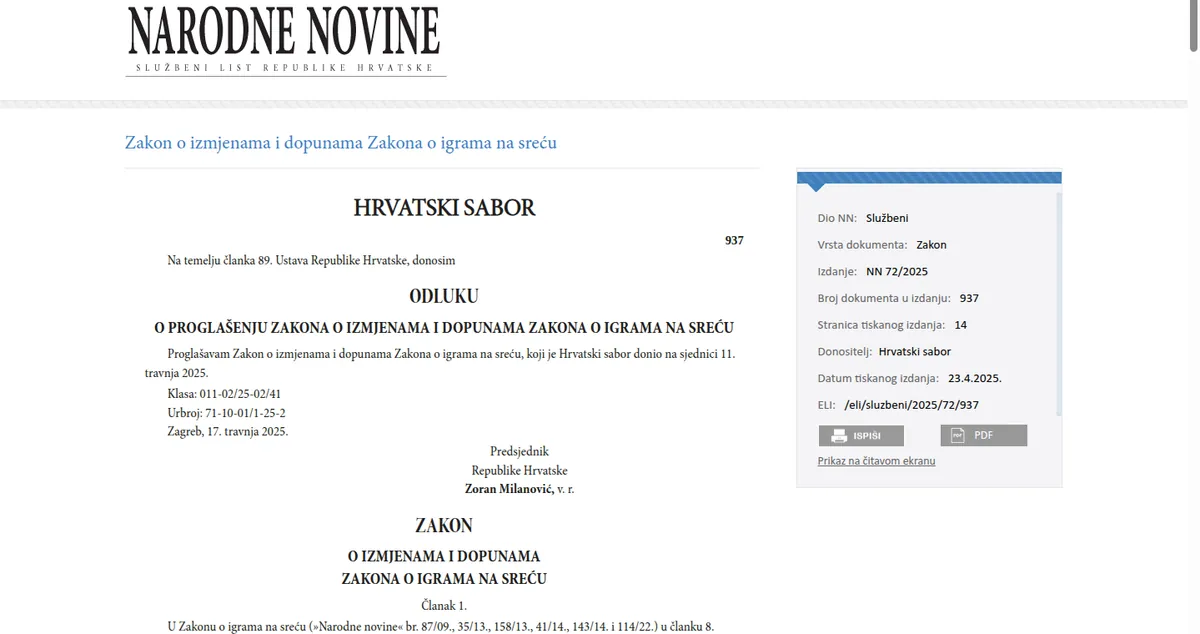
Seven numbers in the header of the Act
The run in the header is not decoration but a short history of the market, and it is worth reading as one.
The base text carries the mark 87/09, that is the year 2009. Two amendments follow in 2013 and two in 2014, then a gap of eight years to 114/22, and finally 72/25.
The rhythm is uneven, then: two years of dense intervention, a long quiet stretch, then two interventions in three years. The 2025 amendment is the third in that newer wave and the first to write into the Act a fine addressed to a natural person outside the role of organiser.
What did not change in that run matters just as much. The mechanism for acquiring the right in article 3 and the exclusive right in article 9 have stood from the beginning, and none of the seven numbers in the header touched them; they are set out on the page about Hrvatska Lutrija.
Three deadlines from the transitional article
Transitional article 19 splits the duties into two groups, with two different dates.
By 1 January 2026 operators must align their business with article 49, paragraph 1, that is with the identification of players at betting counters and terminals. The same date applies to the provisions on advertising and responsible organising in articles 67 and 67.b to 67.d.
By 30 June 2026 the Croatian Institute of Public Health must establish the self-exclusion register under article 67.e, paragraph 6.
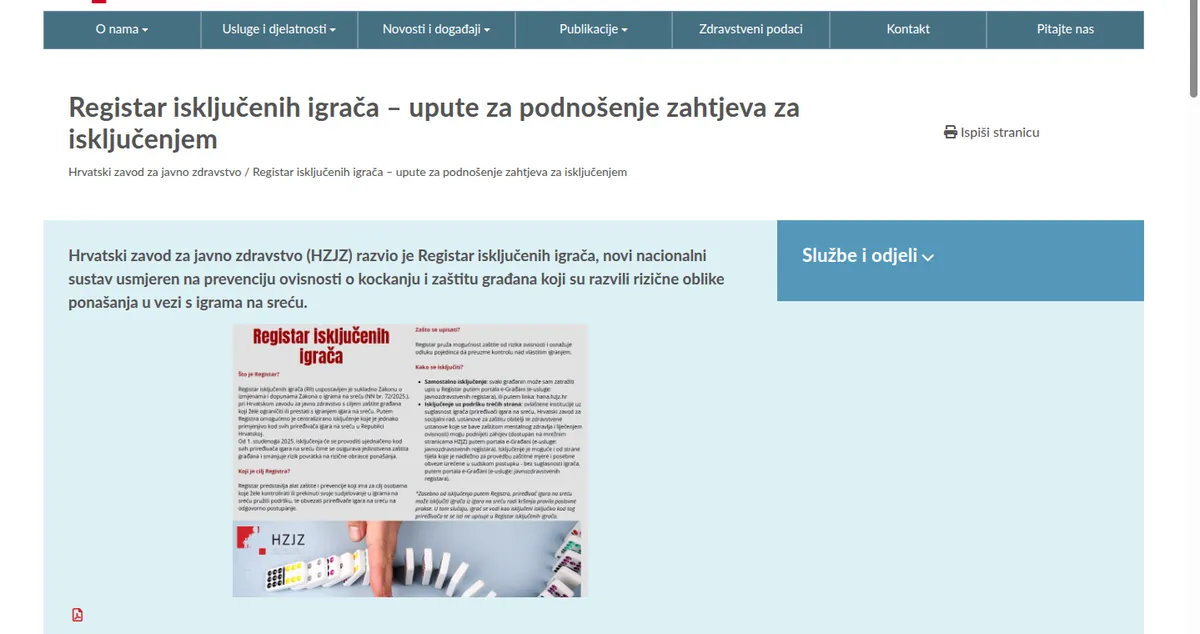
The second deadline has in practice already been met, and well before it expired: according to the Institute’s own page, the register began operating on 1 August 2025. A deadline and a start of operation are two separate facts, and we keep them that way; the entry procedure is described on the page about the register of excluded players.
The advertising fine, the novelty in the same amendment
Article 73 gained a paragraph addressing a natural person outside the role of organiser.
A fine of 3,980 to 6,630 euros is set for a natural person who advertises games of chance: on the internet, in audiovisual and radio programmes, in electronic editions, in print or on publicly accessible surfaces.
Its scope is wider than it looks at first glance, because it also reaches content authors and streamers, that is people who show a game to their audience. Both paragraphs of the same article, with their ranges and with the distinction from taking part, are set out on the page about the fine for advertising.
Five places of publication in the new paragraph
The advertising fine is tied not to one medium but to a list of them, and that list is worth having in view.
It contains the internet, audiovisual and radio programmes, electronic editions, print and publicly accessible surfaces. The first item is the widest and covers publication that is not experienced as an advertisement: a recording of play, a recommendation in a comment, a screen showing a win.
Because of that first item the provision reaches content authors and streamers, people with no role at all in organising a game. The consequence is visible in Croatian texts about gambling, from which offer amounts and promo codes have disappeared; why there are none here either sits on the page about the no-deposit bonus.
How to check that amendment yourself
The procedure takes about ten minutes and requires nothing but two open documents.
- Open the publication in Narodne novine under number 72 of 2025 and find its last article, the one on entry into force.
- Count eight days from the date of publication. The eighth day is the date of application, and here that is 1 May 2025.
- Compare the date you get with the marking in the header of the consolidated text of the Act. If they diverge, trust the official gazette rather than the consolidated version.
- Return to the transitional provisions of the same publication and copy the deadlines with their paragraph numbers. Without a paragraph number a deadline cannot later be checked.
That procedure separates three dates that summaries usually merge into one: the day of publication, the day of entry into force and the deadline for alignment. Why we record a date of reading beside every claim is described in reading documents.
What the amendment did not change
The way the right to an online casino is acquired stayed as it was. Article 35, paragraph 2 still ties it to a company that already holds the right to organise in a casino on premises, so even after 2025 a foreign operator has no procedure to enter. The mechanism is described on the page about who holds an approval.
The basis for blocking addresses is unchanged too. A blocking order still rests on the General Tax Act rather than on the gaming one, as the page about the list of blocked addresses shows.
And the allocation of responsibility in article 49, paragraph 3 remains: enforcement of the prohibitions rests with the operator. The provision in the other statute, punishing gambling in a public place, gained no new reach in this amendment either, which the page about gambling in a public place covers.