
Organising and advertising, not taking part
The Act reaches an individual through two paragraphs of one article
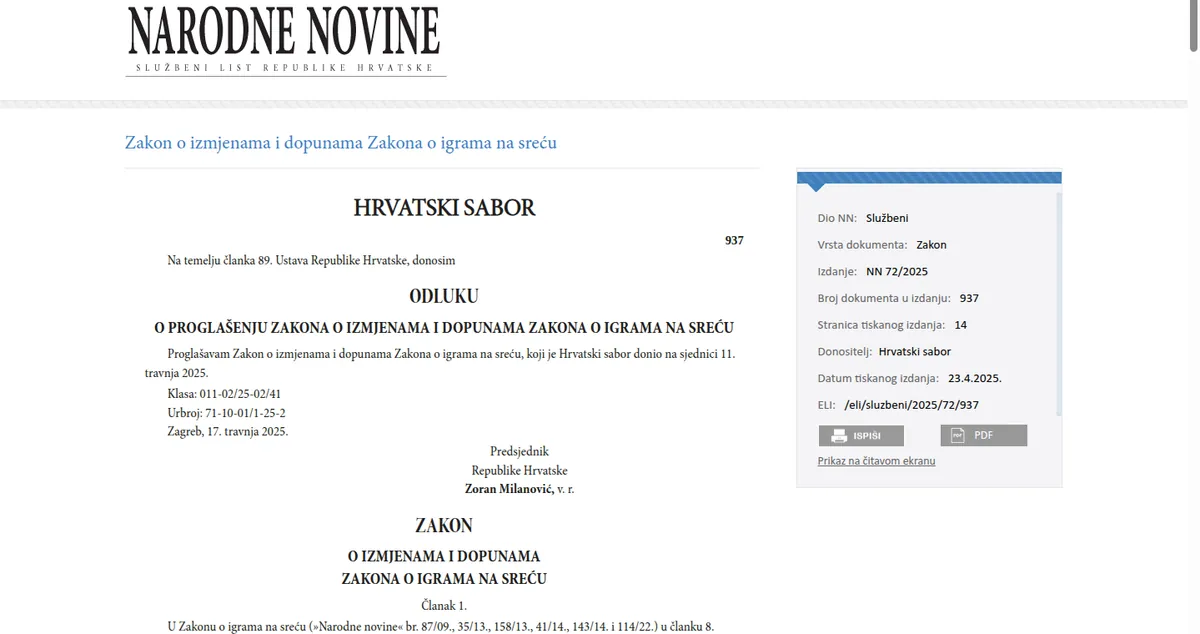
Article 73 is the only place where the Croatian Gaming Act addresses a natural person, and it does so in 2 roles: as the organiser of a game, with a fine of 3,980.00 to 13,270.00 euros, and as an advertiser, with a fine of 3,980 to 6,630 euros.
| Casino | Licence | Company | Threshold for checks | Open |
|---|---|---|---|---|
| Vave | Curaçao Gaming Authority | Latcas B.V. | at discretion | Go to the casino siteRead |
| Vave pays for the single link that leaves this site, and that is the whole of our commercial relationship with it. Its sportsbook and its casino sit on one account, so the same money covers both without a second stake — uncommon among operators that advertise themselves as crypto casinos. We read the licence number ourselves on 2 September 2026 in the Curaçao Gaming Authority register: OGL/2024/1676/0905, held by Latcas B.V., issued 19 May 2025, status active. | ||||
| Rocketpot | Curacao | Danneskjold Ventures B.V. | US$2,500 | Go to the casino siteRead |
| Bitcasino.io | Curaçao Gaming Authority | Moon Technologies B.V. | 2,500 EUR | Go to the casino siteRead |
| Wild Fortune | Anjouan Gaming Board | Metlait SRL | at discretion | Go to the casino siteRead |
| DuckDice | Anjouan Gaming Board | Zentari Limitada | at discretion | Go to the casino siteRead |
| Empire.io | Anjouan Gaming Board | Pixel Entertainment Limited | 2,000 USDT | Go to the casino siteRead |
| Metaspins | Curaçao Gaming Authority | Metaspins N.V. | at discretion | Go to the casino siteRead |
| Rainbet | Anjouan Gaming Board | RBGAMING N.V. | at discretion | Go to the casino siteRead |
| Shuffle | Curaçao Gaming Authority | Natural Nine B.V. | at discretion | Go to the casino siteRead |
| Wild.io | Curaçao Gaming Authority | Nonce Gaming B.V. | at discretion | Go to the casino siteRead |


Two paragraphs, two different acts
The chapter on offences addresses the operator almost throughout. Article 73 is the exception, because it says “fizička osoba”, a natural person, in so many words.
Paragraph 1 reads:
“Novčanom kaznom od 3980,00 do 13.270,00 eura kaznit će se fizička osoba ako priredi igru na sreću iz članka 5. stavka 1. ovoga Zakona.”
A fine of 3,980.00 to 13,270.00 euros shall be imposed on a natural person who organises a game of chance under article 5, paragraph 1 of this Act.
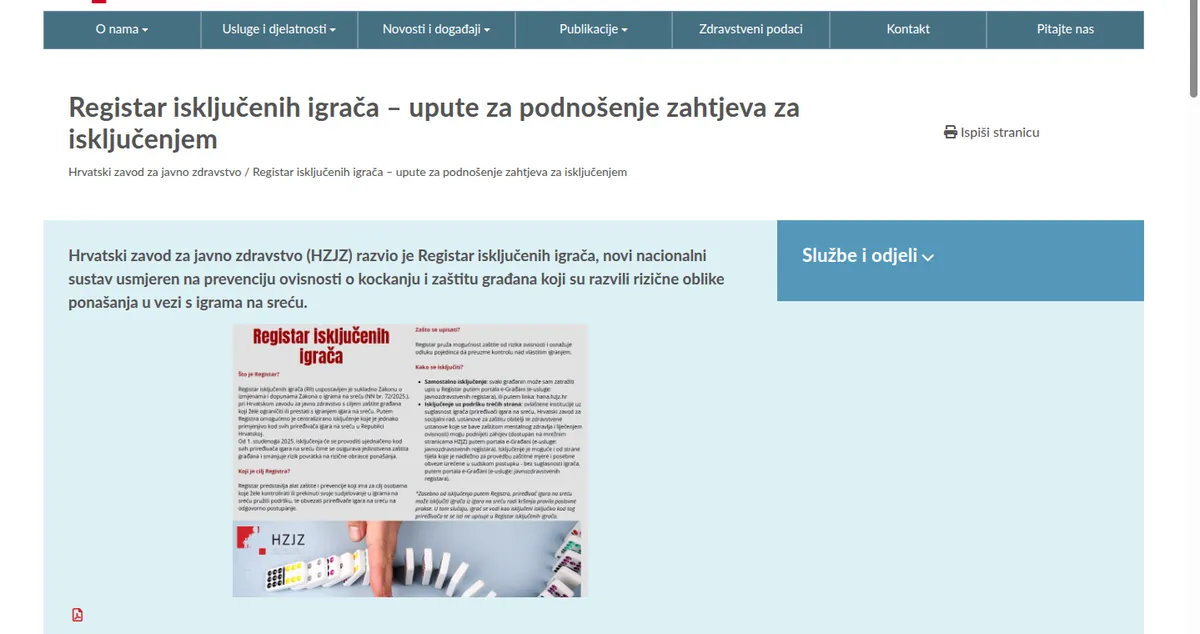
Paragraph 3 of the same article has, since 2025, added a second count: a fine on a natural person who advertises games of chance, starting at the same 3,980 euros and stopping at 6,630.
There are two acts, then, organising and advertising. Taking part is neither of them, and the article passes over it in silence.
It is also worth noticing whom the article does not address. Throughout the rest of the chapter the addressee is the operator, that is a commercial company, and the fines there are drafted for a legal person and for the responsible person within it. Article 73 steps out of that run and names an individual directly, which makes it the only place where a Croatian player needs to stop and read the sentence to the end.
What article 5 refers to in that sentence
The first paragraph does not speak about gambling in general. It punishes whoever organises “igru na sreću iz članka 5. stavka 1. ovoga Zakona”, a game of chance under article 5, paragraph 1 of this Act, so the cross-reference is part of the provision itself.
Article 5, paragraph 1 lists four kinds: lottery games, casino games, betting games and slot games. All four therefore fall within the reach of that fine, from a bingo evening in a hall to a screen of slot machines.
That is also where the size of the range comes from. The legislator is not measuring entertainment but a business, and the business is the same whichever of the four kinds is organised. Which right the Act assigns to whom is set out on the page about Hrvatska Lutrija.
The first paragraph requires you to open a game to others
The verb carrying the whole paragraph is “priredi”, organises. It describes the person who sets up and runs a game, that is who holds the stake, the rules and the outcome.
Whoever plays on somebody else’s site has no place in that sentence. The Act keeps that distinction consistently through the whole chapter: counts about participation are drafted as “dopusti sudjelovanje”, allows participation, and only whoever holds the door can allow. What those formulations look like in the original is shown on the page about what the Act says.
The size of that range shows how the legislator regards the act. This is about organising without approval, that is about a business rather than a pastime.
Two figures with the same starting point
The ranges of the two fines are worth setting side by side, because their lower bound is identical.
Organising: 3,980.00 euros at the bottom, 13,270.00 at the top. Advertising: 3,980 at the bottom, 6,630 at the top.
The same starting figure means the legislator values entry into both offences equally. The difference is in the ceiling, twice as high for organising, and that is the only gap between the two roles that can be read out of the numbers.
How a fine is set within the range is not visible from the text. We have not read the case law, so there is no claim here about typical amounts.
The second paragraph lists five places of publication
The advertising fine is not tied to one medium but to a list of them. It contains the internet, audiovisual and radio programmes, electronic editions, print and publicly accessible surfaces.
Because of the first item on that list, the provision reaches publication that no one experiences as an advertisement. Under the 2025 amendment it also reaches content authors and streamers, that is people who show a game to their audience with no role whatsoever in organising it.
That is also where the change a Croatian reader sees in texts about gambling comes from: offer amounts and codes have withdrawn from them. Why there is not a single such figure here either is set out on the page about the no-deposit bonus.
Why that fine is easy to miss
The advertising provisions and the sanction for them do not sit in the same place in the Act.
The rules are in article 67 and in articles 67.b to 67.d, in the part on socially responsible organising. The fine is in article 73, in the chapter on offences, that is a dozen pages further on.
A reader who opens the advertising part finds duties, not amounts. A reader who opens the offence provisions finds amounts, with no context. To read the provision whole you have to assemble it from two parts of the Act, and that is exactly why summaries pass it on by halves.
The deadline that goes with the advertising rules
The same amendment also set a date. Transitional article 19, in paragraph 7, ties the provisions on advertising and responsible organising, articles 67 and 67.b to 67.d, to the deadline of 1 January 2026.
That is the second deadline in that article. The first concerns the identification of players at betting counters, and the third the establishment of the self-exclusion register by 30 June 2026. All three are kept apart on the page about the 2025 amendment.
What these two paragraphs do not settle
They leave the addressee of the rest of the Act unchanged. Responsibility for enforcing the prohibitions in article 49 still rests with the operator, under paragraph 3 of that article.
They leave the blocking of addresses untouched. A blocking order is issued under the General Tax Act and addressed to intermediaries, which the page about the list of blocked addresses covers.
They stop short of gambling in public space. That provision sits in the Act on Offences against Public Order and Peace and has a reach of its own, set out on the page about gambling in a public place.
The boundary of this reading
We read the text of article 73 and of transitional article 19. We have not opened the secondary legislation adopted under the Act and we have not read the case law, so there is no claim here about how often these fines are imposed or how they are set within the given range.
Nor is there legal advice. Anyone who needs an interpretation for their own case needs a lawyer, not a transcribed article; how we draw that line is described on the page about reading documents.
Why offer amounts are disappearing from Croatian pages
The consequence of the advertising paragraph is visible above all on pages describing offers.
A bonus amount, a free-spin count and a promo code published alongside an invitation to play fall within the description that provision reaches, so content authors write them less and less. What remains is a description of how an offer is built, explaining how its value is calculated, without a single figure from the offer itself.
What such a description looks like is shown on the page about the welcome bonus.