
Three published amounts, seven discretionary powers
When an operator asks for papers, and under what rule
Only 3 of the 10 operators in our table publish a threshold above which they ask for identity papers. The rest reserve their own assessment, and that is written into their terms.
| Casino | Licence | Company | Threshold for checks | Open |
|---|---|---|---|---|
| Vave | Curaçao Gaming Authority | Latcas B.V. | at discretion | Go to the casino siteRead |
| Vave pays for the single link that leaves this site, and that is the whole of our commercial relationship with it. Its sportsbook and its casino sit on one account, so the same money covers both without a second stake — uncommon among operators that advertise themselves as crypto casinos. We read the licence number ourselves on 2 September 2026 in the Curaçao Gaming Authority register: OGL/2024/1676/0905, held by Latcas B.V., issued 19 May 2025, status active. | ||||
| Rocketpot | Curacao | Danneskjold Ventures B.V. | US$2,500 | Go to the casino siteRead |
| Bitcasino.io | Curaçao Gaming Authority | Moon Technologies B.V. | 2,500 EUR | Go to the casino siteRead |
| Wild Fortune | Anjouan Gaming Board | Metlait SRL | at discretion | Go to the casino siteRead |
| DuckDice | Anjouan Gaming Board | Zentari Limitada | at discretion | Go to the casino siteRead |
| Empire.io | Anjouan Gaming Board | Pixel Entertainment Limited | 2,000 USDT | Go to the casino siteRead |
| Metaspins | Curaçao Gaming Authority | Metaspins N.V. | at discretion | Go to the casino siteRead |
| Rainbet | Anjouan Gaming Board | RBGAMING N.V. | at discretion | Go to the casino siteRead |
| Shuffle | Curaçao Gaming Authority | Natural Nine B.V. | at discretion | Go to the casino siteRead |
| Wild.io | Curaçao Gaming Authority | Nonce Gaming B.V. | at discretion | Go to the casino siteRead |


Three amounts written into a contract
At 3 of the 10 operators in the table the amount is written down, and with a clause number against which it can be checked.
Bitcasino.io states 2,500 EUR in clause 6.6 of its terms. Rocketpot states 2,500 USD in clause 11.4. Empire.io states 2,000 USDT in clause 5.4.
Wording of that kind has practical value: the amount is known in advance, so you know where the line is before the first payout. The currency is the one in the terms and is not converted, because a threshold is a contract clause rather than a price that follows an exchange rate.
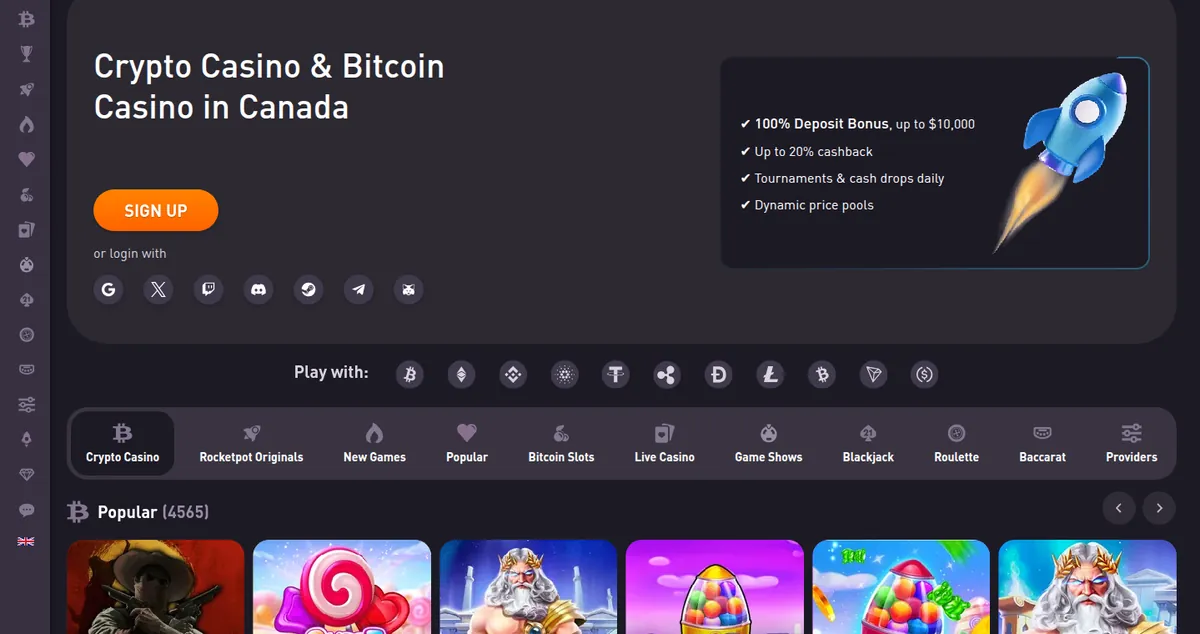
Three thresholds in three different currencies
The figures look comparable until you look at the mark beside them.
Bitcasino.io states 2,500 in euros, Rocketpot 2,500 in dollars, Empire.io 2,000 in USDT. The first two figures are identical, their currencies are not, and so the thresholds are not equal either.
We do not convert them, and that is deliberate. A threshold is a contract clause in the currency it is written in; an exchange rate changes daily, the clause does not. A converted figure would look more precise and would hold only on the day it was calculated.
The third figure is the lowest and also the only one expressed in a crypto unit pegged to the dollar. Anyone counting in euros reaches that house’s threshold earlier than the other two.
What all three share is a shape: an amount, then a clause number. Without the clause number the claim could not be checked, and then we would not have written it down at all.
Six operators reserve their own assessment
At the other six the terms carry a power rather than a figure. Papers may be requested when the operator judges it necessary, and the clause saying so exists: 18.1 at Wild Fortune, 9.7 at Metaspins, 4.1 at Shuffle. At Rainbet there are two places, 5.2 and 8.3, while DuckDice handles it in a different section of its terms.
The difference from the first group is not strictness but predictability. A published 2,500 EUR says where the line is; a discretionary power means papers may be requested before any payout, including the first and the smallest.
A seventh case is its own thing and worth naming. At Wild.io the rule is described but we did not record the clause number, so the table carries what was actually read, without an invented reference.
Where that power usually hides
The wording that identifies a discretionary check rarely sits under a heading about verification.
At Wild Fortune the clause is 18.1, at Metaspins 9.7, at Shuffle 4.1. The numbers are spread across the whole document, from the fourth section to the eighteenth, depending on how each house arranged its terms.
At Rainbet the same power appears in two places, clauses 5.2 and 8.3, and at DuckDice in a separate section with no clause number at all.
The practical consequence is simple: searching by section heading misses. You search for the wording, not the heading, and that is why every figure here carries the clause number we found it under.
The tenth case: a rule without a figure
At the tenth brand, Vave, there is no amount in the contract, but the rule is written down. Clause 8.7 ties the check to every payout and to the operator’s assessment, with a 14-day deadline for supplying papers and a stated consequence if the deadline is missed.
That row of the table therefore reads “at discretion” rather than a figure. From the absence of an amount it does not follow that there is no check; it follows only that no line has been published, so the operator’s later conduct has nothing to be measured against.
Elsewhere in the table a blank field means a third thing: that we did not read the fact. Not zero, not unlimited, and not confirmation that no rule exists. An unpublished clause read as non-existent turns a gap in the data into an advantage for the operator, and that is precisely the mistake these pages try not to repeat; the rule is written down in reading documents.

What Croatian law requires on identification
Precision matters here, because the provision is often stretched beyond what it says.
Article 49, paragraph 1 reads: “Sudjelovanje u igrama klađenja i igrama na automatima koje se priređuju na uplatnim mjestima kladionica dopušteno je samo osobama koje su se identificirale.” — participation in betting and slot games offered at betting shop counters is permitted only to persons who have identified themselves. This is about betting shop counters, that is about physical locations.
Paragraph 2 sets the age limit of 18, and paragraph 3 assigns responsibility for enforcing both prohibitions to the operator. The deadline for aligning with paragraph 1 was set by transitional article 19, paragraph 3 at 1 January 2026, which the page about the 2025 amendment covers.
The corresponding offence count is again drafted against the operator: point 28 punishes whoever “dopusti sudjelovanje”, allows participation, by a person who has not identified themselves. The whole run sits on the page about what the Act says.
What a threshold says nothing about
A threshold answers the question of when papers will be requested. How long the check will take is answered by none of the clauses we read.
Processing time does not appear in the terms we read as a figure we could copy. It is missing at the three houses with a published threshold and at the seven with a case-by-case power.
That is why there is no sentence here about a payout within a few hours. We hold no account with these houses and did no measuring, so any such figure would be borrowed from somebody else’s text.
What is visible from the documents is the other half of the arithmetic, the upper limit on the amount, published by four houses with a clause number; those figures are carried by the page about payout limits.
How to read that clause yourself
The procedure takes a few minutes and works at all ten operators in our table.
- Open the terms of use and look for the section on verification, usually under the word Verification or KYC.
- Check whether it contains an amount or only a power. Wording of the “may request at any time” kind means discretion.
- Write down the clause number and the company name the terms give. Without the clause number the claim cannot be checked, and the company name tells you who receives the documents, which the page about the company behind the brand covers.
- In the same document look for the section on the payout ceiling, because those two rules jointly decide when money leaves; the figures sit on the page about payout limits.
A foreign licence number says nothing about this question, as the page about foreign licences sets out.
Where each of those rules is read
The clause on papers at each house sits beside the rest of what was read about it, on its own page.
- Bitcasino.io: a threshold of 2,500 EUR under clause 6.6, the only one written in euros.
- Rocketpot: a threshold of 2,500 USD under clause 11.4.
- Empire.io: a threshold of 2,000 USDT under clause 5.4, the lowest of the three.
- Vave: no published threshold, with the deadline and the consequence of missing it in clause 8.7.
At the other six houses the clause stays at the level of a power, so no amount stands beside it.