
A brand outside our table
Vavada online casino: three checks instead of a verdict
Vavada is not among the 10 operators whose documents we read, so there is not a single figure about that brand here. What remains are 3 checks a reader can make alone, all three free and all three public.
Why a brand name does not answer the question
A name typed into a search box returns adverts, lists and the odd text that looks like a review. None of that is a document.
The facts that decide whether money comes out and when sit in three places, and all three are public: in the list kept by the Ministry of Finance, in the register of the body that issued the licence, and in the house’s own terms. Whoever reads those three knows more than any sum of scores.
There is no data on that brand here
Our table has ten rows and Vavada is not one of them. We did not open its restricted-territory list either, while at nine houses in the table it was read, as set out on the page about Croatia in the operators’ terms. We did not open its terms, we did not check its licence number in a register and we did not read a single clause of its contract.
That is why there is no payout ceiling here about it, no threshold for papers, no coin list and no register status. Writing any of that without reading would mean inventing a fact, and that is the one thing these pages do not allow themselves; the rule sits on the page about reading documents.
What follows is therefore not a verdict on a brand. It is a procedure that applies to any brand somebody looks for by name.
Check one: the Tax Administration list
Ministarstvo financija, Porezna uprava — the Ministry of Finance, Croatian Tax Administration — publishes “Popis web adresa priređivača igara na sreću za koje je izdan nalog o zabrani rada”, the list of operator web addresses under a blocking order. The file is an xlsx spreadsheet, downloaded directly and searched by typing in a domain.
The legal basis named beside the list comes from tax law rather than gaming law: Opći porezni zakon, the General Tax Act, article 44, paragraph 3, elaborated by the implementing rulebook in articles 18 to 21. The order is executed within 15 days of issue.
The answer that list gives is narrow, and valuable precisely for that. A domain is either in it or not, and neither says anything about how a house pays out. Where the file sits and what it will not contain is described on the page about the list of blocked addresses.
Check two: the licence number and its register
A licence number usually sits in the footer of a site or in its terms, beside the company name.
The format of the number shows which register it belongs to. Marks beginning with OGL are checked in the certificates at cert.cga.cw, marks beginning with ALSI in the public register of the Anjouan Gaming Board. In our table there are four of the first format, four of the second, and one operator carries the older Curaçao form marked 1668/JAZ.
Comparing names matters more than the number itself. A brand name and a company name are rarely the same thing, and a dispute is with the company. What such a record confirms, and what it does not, is set out on the page about foreign licences.
The check that is skipped most often
Alongside three public checks there is a fourth, and it sits in the same document as the two clauses about money.
The restricted-territory list enumerates the countries a house will not take players from. It arises from the house’s own decision, changes without notice and is published nowhere as a register, which makes it the only fact about Croatia an operator publishes itself.
Two cautions apply when searching. A country is written both as Croatia and as the two-letter code HR, so a search for one form misses half the cases. And the list is sometimes pulled out of the main text into a separate annex or a separate policy, so a search of the front page of the terms misses it.
At nine houses in our table we read that list and Croatia is absent from it; what that absence means is described on the page about Croatia in the operators’ terms.
Check three: two clauses in the terms
In every house’s terms there are two clauses that jointly decide the outcome.
The first is the rule on asking for documents. At three houses in our table an amount is written down, at six only a power without a figure, and the difference between a predictable threshold and a case-by-case assessment is described on the page about identity checks.
The second is the upper payout limit. At four houses it is published with a period and a clause number, and the range between them runs from 5,000 USD a month to a million USDT a week, as the page about payout limits shows.
If you cannot find those two clauses in the terms of a brand you are checking, that is itself a finding.
Why this procedure works for any other brand
The order of the three checks is not arbitrary: each next one costs more time and answers a narrower question.
The first takes a minute and answers the state’s question. The second takes a few minutes and answers the issuer’s question. The third takes longest and is the only one that answers the question about money.
Whoever stops after the first knows only whether a domain is under an order. Whoever stops after the second knows a company name and a record status, but nothing about payouts. The answer they came for lies in the third, and that is why it is the one not worth skipping.
At the ten houses in our table we went through all three and the result stands in the columns; what may be concluded from those columns is shown on the page about how the choice is made.
What Croatian law says about this
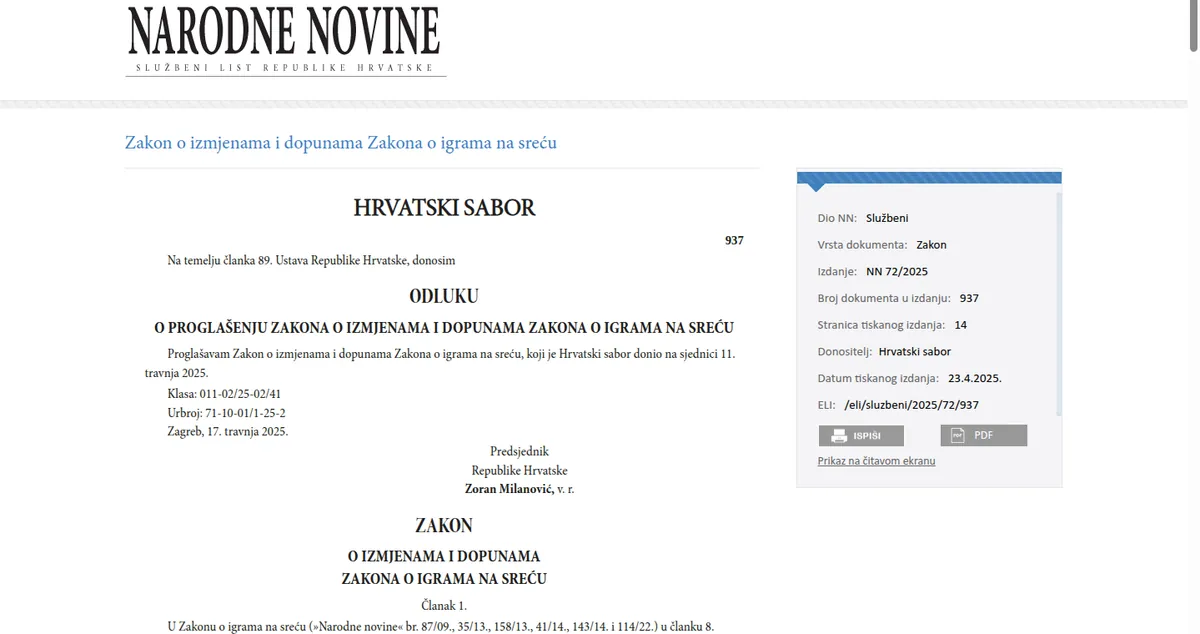
Croatian law does not punish taking part in a game. The offence counts are drafted against the operator, article 49, paragraph 3 says expressly that responsibility for enforcing the prohibitions rests with the operator, and the only fine addressed to a natural person, article 73, paragraph 1, hits whoever organises a game.
Advertising is a different matter. Since the 2025 amendment a natural person who advertises games of chance faces a fine of 3,980 to 6,630 euros, which also reaches content authors who show a brand to their audience.
The provision search results most often serve up as proof that a player is liable — article 8 of the Act on Offences against Public Order and Peace — holds to the condition “na javnom mjestu”, in a public place, and stops there; it is set out on the page about gambling in a public place. The whole run of provisions sits on the page about what the Act says.
A foreign brand cannot obtain a Croatian approval in any form, because under article 35, paragraph 2 it goes only to a company that already holds the right to a casino on premises; the mechanism is described on the page about an online casino in Croatia.