
A provision that sits outside the Gaming Act
The provision most often quoted outside its own reach
The fine under that provision runs up to 2000.00 euros or up to 30 days in custody, and its entire reach is held by three words at the start of the sentence.
| Casino | Licence | Company | Threshold for checks | Open |
|---|---|---|---|---|
| Vave | Curaçao Gaming Authority | Latcas B.V. | at discretion | Go to the casino siteRead |
| Vave pays for the single link that leaves this site, and that is the whole of our commercial relationship with it. Its sportsbook and its casino sit on one account, so the same money covers both without a second stake — uncommon among operators that advertise themselves as crypto casinos. We read the licence number ourselves on 2 September 2026 in the Curaçao Gaming Authority register: OGL/2024/1676/0905, held by Latcas B.V., issued 19 May 2025, status active. | ||||
| Rocketpot | Curacao | Danneskjold Ventures B.V. | US$2,500 | Go to the casino siteRead |
| Bitcasino.io | Curaçao Gaming Authority | Moon Technologies B.V. | 2,500 EUR | Go to the casino siteRead |
| Wild Fortune | Anjouan Gaming Board | Metlait SRL | at discretion | Go to the casino siteRead |
| DuckDice | Anjouan Gaming Board | Zentari Limitada | at discretion | Go to the casino siteRead |
| Empire.io | Anjouan Gaming Board | Pixel Entertainment Limited | 2,000 USDT | Go to the casino siteRead |
| Metaspins | Curaçao Gaming Authority | Metaspins N.V. | at discretion | Go to the casino siteRead |
| Rainbet | Anjouan Gaming Board | RBGAMING N.V. | at discretion | Go to the casino siteRead |
| Shuffle | Curaçao Gaming Authority | Natural Nine B.V. | at discretion | Go to the casino siteRead |
| Wild.io | Curaçao Gaming Authority | Nonce Gaming B.V. | at discretion | Go to the casino siteRead |


The sentence in full
Texts claiming that a Croatian player risks a fine almost always lean on 1 provision, and it sits outside the Gaming Act. Here it is in full, from Zakon o prekršajima protiv javnog reda i mira, the Act on Offences against Public Order and Peace:
Article 8: “Tko se na javnom mjestu kocka ili tko mami druge na kocku ili tko omogućava kockanje, kaznit će se za prekršaj novčanom kaznom u iznosu od 300,00 do 2000,00 eura ili kaznom zatvora do 30 dana.”
In English: whoever gambles in a public place, or lures others into gambling, or enables gambling, commits an offence punishable by a fine of 300.00 to 2000.00 euros or by imprisonment of up to a month, capped at 30 days.
The sentence has three acts: gambling, luring others, and enabling. All three sit behind the same opening condition, which is written before them and applies to all of them.
Three acts under one condition
The sentence is worth taking apart, because quotations usually carry only its first half.
The first act is to gamble. The second is to lure others into gambling. The third is to enable gambling, and it is the widest of them, because it covers anyone who makes a space or an opportunity available.
All three, however, hang on the same opening condition. The words “na javnom mjestu”, in a public place, stand before the first act and apply to the entire run, so even the widest of them does not leave public space.
Because of that construction, a text quoting only the third act sounds as though it catches anyone who facilitates play in any way. The condition limiting it stayed above the quotation.
The condition that sets the reach
The condition is “na javnom mjestu”, in a public place, and the whole provision depends on it. That statute, by its own title, governs conduct in public space: the street, a hospitality venue, a public gathering. Play on your own device, in your own home, sits outside that description.
That is also why the provision is in that Act rather than in the gaming one. These are two different bodies of regulation with two different purposes, and the only theme they share is the word gambling.
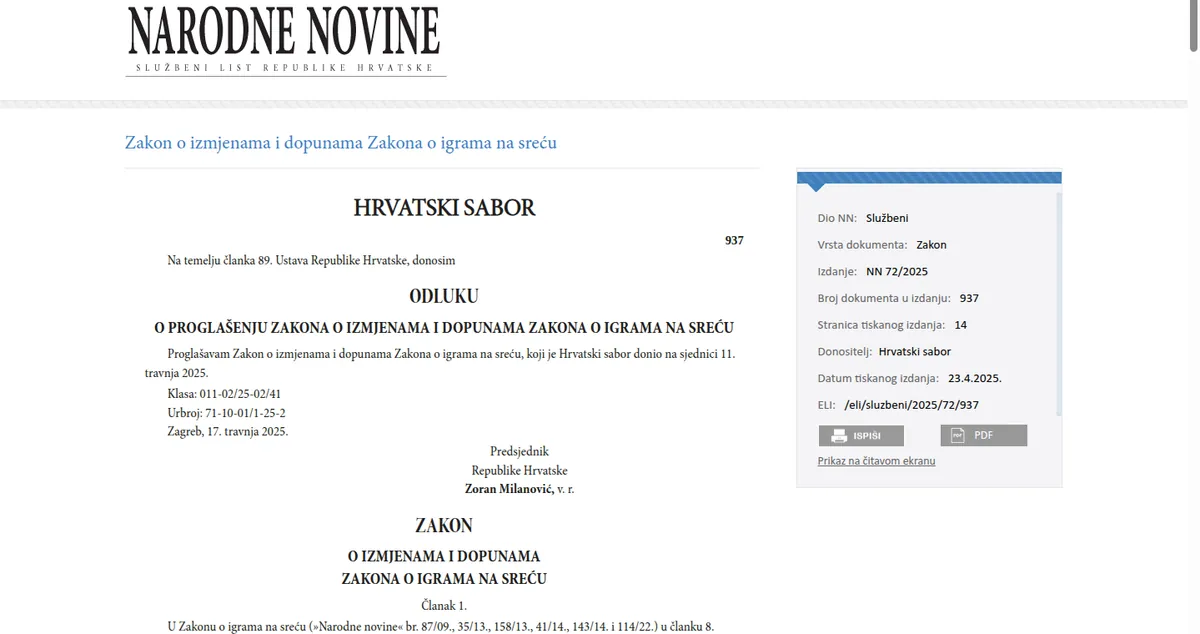
The image beside this text shows the other statute, the 2025 amendment to the Gaming Act. Article 8 is not in it and never was, because it belongs to a different Act; what that amendment did bring sits on the page about the 2025 amendment.
Here it is worth being explicit about the limits of our own knowledge: we read the text of the provision but not the case law around it, so nothing is claimed here about how the courts apply it.
Why the provision sits in that particular Act
The Act on Offences against Public Order and Peace names its subject in its own title, and that title explains where article 8 sits.
Its subject is order in space shared by everyone: the street, a hospitality venue, a public gathering. Gambling appears in that run as one of the behaviours that disturb such order, alongside shouting, brawling or begging, and not as an economic activity.
Games of chance as an activity are governed by a different statute, with its own approvals, supervision and registers. The two Acts therefore do not cover the same ground: the first looks at how people behave outdoors, the second at who may take a stake. The division of the right to organise is set out on the page about Hrvatska Lutrija.
The same construction in another country
The structure is worth noticing because it repeats. The Hungarian Offences Act of 2012, in its provision on prohibited games of chance, punishes anyone who organises such a game or takes part in it “közterületen vagy nyilvános helyen” — on a public area or in a public place. The same limiter, the same position in the sentence, the same consequence for play at home.
In both countries search results serve up precisely this provision as proof that the player is liable. In both it speaks about street play. What that confusion looks like when a specific brand is being searched for is shown on the page about the query for Vavada online casino.
Two ranges from two different statutes
The figures in this provision are worth putting beside the ones in the Gaming Act, because the gap between them says something about purpose.
Here: at most 2000.00 euros, with imprisonment of up to 30 days possible. In the Gaming Act, for a natural person who organises a game: from 3,980.00 to 13,270.00 euros.
The upper limit differs by a factor of six and a half. An offence against public order is measured as a disturbance of order in a space, then, and organising a game without approval as an economic act. Both ranges, with their paragraphs, sit on the page about the fine for advertising.
Imprisonment exists only in the first of those two provisions, and that is the difference texts about the Croatian market routinely transfer to the wrong place.
Where the claim about a fine on players comes from
There are three sources of the misunderstanding, and they are worth separating.
The first is mixing up organising with taking part. Article 73 of the Gaming Act fines a natural person who organises a game, from 3,980.00 to 13,270.00 euros, and that is an entirely different act from playing. The difference is set out on the page about what the Act says.
The second is domain blocking. When the Tax Administration issues a blocking order, the order goes to an intermediary and its deadline is 15 days. That measure hits the operator and access, which the page about the list of blocked addresses covers.
The third is the phrase in this domain name itself. Since it does not exist in the sense of a licence a foreign operator could obtain, it reads easily as a description of somebody’s breach. In fact it describes the shape of a market, as the page about who holds a Croatian approval shows.
What the Act does require of a player
Two duties do exist and are worth knowing.
The age limit is 18, under article 49, paragraph 2, and the same article assigns enforcement of that prohibition to the operator in paragraph 3.
Advertising games of chance has carried a fine for a natural person since 2025: from 3,980 to 6,630 euros, under article 73, paragraph 3. That provision reaches content authors and streamers, that is somebody who promotes a game, not somebody who plays it. Its scope and date of entry are described on the page about the 2025 amendment.
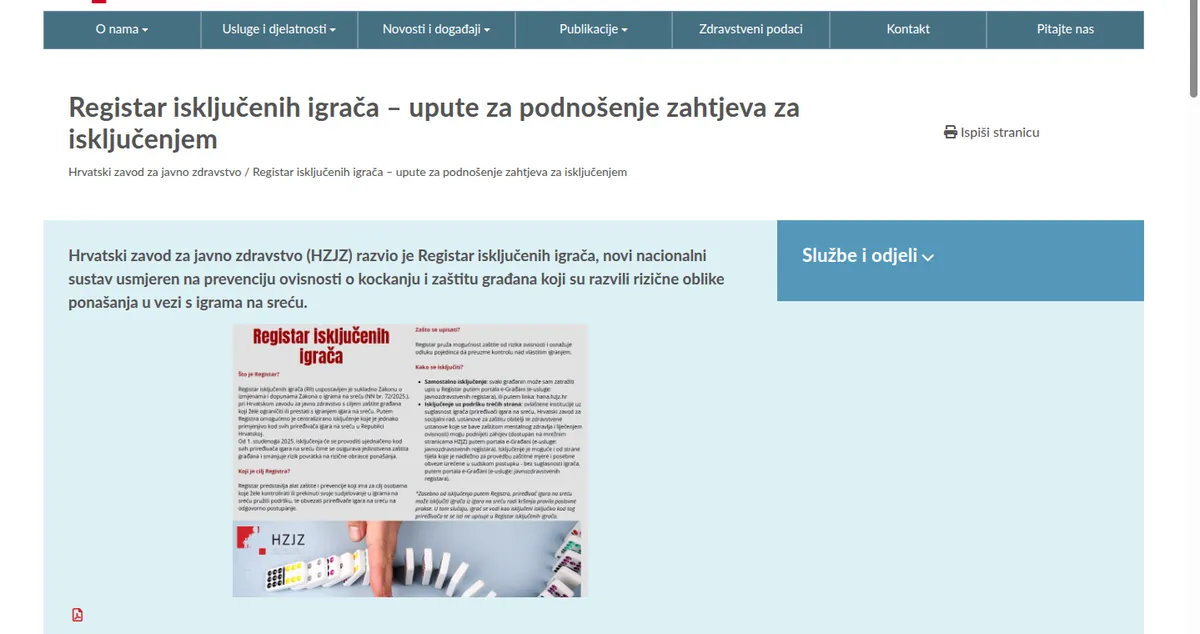
A tool that genuinely exists on the player’s side is voluntary self-exclusion through the Croatian Institute of Public Health, described on the page about the register of excluded players.